


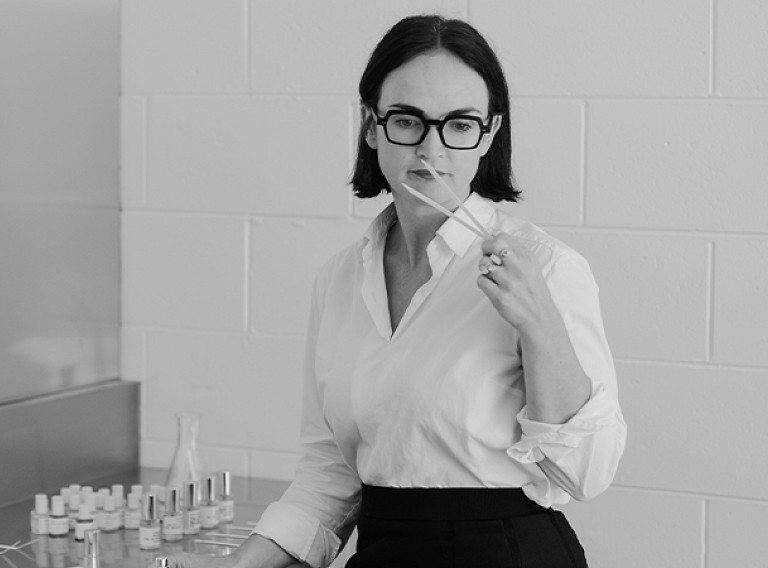
Natural fragrances have been in high demand, expected to reach a global market value of $20.8B by 2024. But for creatives like Frances Shoemack, founder of Abel, it’s not just about creating a product devoid of synthetic fragrance notes, but celebrating the full aroma profile and benefits that Mother Nature has to offer. Whether it’s the essential oils or naturally derived single-aroma compounds and organic alcohol base in the formulas, each ingredient has been chosen with utmost discernment.
Based in New Zealand and with products currently sold in 33 countries, the company began in 2011 in Amsterdam, when Shoemack, a winemaker by trade, struggled to find natural fragrances that suited her taste. Launched in 2013, today Abel has a curated lineup of 100% plant-derived, cruelty-free, and vegan fragrances made with ethically sourced ingredients (a majority of which are courtesy of Symrise), packaged in FSC-compostable and Bakelite packaging, sent to customers with low-carbon shipping. A portion of proceeds go to 1% For The Planet and Mary’s Meals.
Created in collaboration with master perfumer Isaac Sinclair, the newest releases from the brand include Pause, designed to balance the mind and body as it goes through hormonal changes, and Cyan Nori, a scent dedicated to the ocean. Pause is a grounding floral offering notes of violet leaf, narcissus, mimosa, and hay—all chosen for their stabilizing and tranquilizing properties. Cyan Nori offsets plant-derived musk with fruity notes of tangerine and peach, topped off with the scent of salt. While the brand began with eau de parfums, it recently released a line of alcohol-free extracts, containing therapeutic-grade essential oils with a 25% concentration.
In a true embodiment of the principle of “kill your darlings,” for every new release into the Abel portfolio, one product is discontinued in a bid to counteract excessive consumerism. The company also discloses all ingredients in its formulations, rather than keeping certain ingredients under the “parfum” label, and is currently petitioning for wider disclosure of ingredients across the entire perfume industry, encouraging its customers to take action and campaign for change.
BeautyMatter sat down with Shoemack to discuss the brand’s international DNA, the evolution and prevailing myths of natural perfumery, and Abel’s crusade for increased transparency and ingredient overhaul.
Starting off, what parallels do you draw between winemaking and perfumery?
Both disciplines are really about where science meets art and finding harmony in the olfactory, which is a pretty singular similarity between the two. When it comes to the way we make perfume at Abel, we’re even further informed by my experience in the wine industry, including the way we bring the ingredients to the fore. In wine, you say you can’t make a good wine with bad grapes, and in perfume, it’s exactly the same. The incredible natural ingredients are what make our fragrances so special , complex, and enduring.
How did spending time between New Zealand and Amsterdam inform your perfumery practice?
Abel’s lucky to have both these incredible places in its DNA. Growing up in New Zealand surrounded by nature has informed my own experiences and palette, as well as that of our master perfumer Isaac Sinclair. Likewise, for both of us, later life experiences living in European global hubs (Paris and Milan for him, Amsterdam for me) have informed the urban aesthetic of the brand.
How would you describe the working partnership with Isaac when it comes to fragrance creation?
Extremely collaborative! Normally Isaac and I sit together in the lab in Paris in the early days of the fragrance development and really firm up the creative concept between the two of us. We go on in this way, with very little involvement from the outside world 。 It’s an awesome working partnership.
What are the challenges of creating an ethical and sustainable supply chain?
If you’re trying to be truly conscious, there are no black-and-white answers. For example, glass is endlessly recyclable, but also heavy (for shipping). Weighing the pros and cons and making decisions based on your brand values is important. I’m always skeptical when I hear brands with sweeping sustainability statements or making it sound simple—it’s not, sustainability is very nuanced. At Abel, we combat that by being very open and transparent with our customers so that even if hindsight proves A decision wasn’t the best, we can show why that decision was made. Basically, we’re trying our hardest and bringing our customers along for the journey.
What are your thoughts on the evolution of the natural perfume category and the rise of clean fragrance?
I’m thrilled to see a natural perfume category beginning to emerge. When I started Abel almost a decade ago, I felt at the time that perfume was really lagging behind other sectors in terms of what is often referred to as “clean.”It took several more years since then for the category to really start to emerge. Like any emerging industry, there’s a bit of ironing out to do around what’s important, or what different terms mean. The great thing is that consumers are ahead of the game, demanding transparency, getting in behind brands doing the right thing, and the industry is aware things can’t continue the way they have done—relying on petrochemicals.
