


Child beauty pageants have a storied legacy in American culture, especially in the Southern states. Advocates of these competitions assert that they encompass much more than just beauty, judgment, or the allure of prizes—although ample rewards are indeed a part of the landscape. Proponents believe these events foster the growth of responsible, talented, and well-mannered young girls. However, a significant backlash emerged following the tragic murder of 6-year-old pageant contestant JonBenet Ramsey in 1996. This led Lise Hilboldt-Stolley to explore the intricate and often contradictory universe of child beauty pageants in a time before social media and television phenomena like Toddlers & Tiaras. Her in-depth investigation into the intense pressures and misconceptions surrounding child pageants, featured in the February 1999 issue of Good Housekeeping, combines thorough reporting with a compassionate perspective. — Alex Belth, Hearst archivist
Thumper Gosney stands out as something truly special. While playing at the pool of the Atlanta Airport Marriott, this 8-year-old exhibits a remarkable fluidity reminiscent of a dancer, with her long hair flowing gracefully around her like seaweed. Thumper naturally attracts the attention of younger children, and soon, two little girls in water wings join her, creating an impromptu sisterhood.
Thumper, whose full name is Leslie, radiates confidence and independence—traits that her mother is keen to nurture. Susan Gosney and her husband, Gary, are somewhat older parents; Thumper’s three sisters are already in their twenties. Their desire is for their youngest daughter to thrive on her own terms, embracing her unique identity and interests without undue pressure.
More From Good Housekeeping
Interestingly, Thumper was once quite shy, a fact her mother highlights. That all changed when Thumper discovered the world of pageants at the age of 5 during a visit to a local county fair in Temple, TX, where an annual beauty competition takes place. Captivated by the dazzling crowns and extravagant gowns showcased by previous winners, Thumper expressed an earnest desire to participate. Susan hesitantly agreed, recalling, “I bought her a beautiful dress, but I made many mistakes. I styled her hair into a tight bun to accentuate the dress, slicking it down to perfection. She resembled a peeled grape in that extravagant gown.”
When JonBenet died, the Gosneys were stunned. Thumper sent flowers to her little friend’s funeral. And then everything began to change.
Thumper faced defeat in her first five pageants, but she remained undeterred. “I didn’t mind,” she reflects now. “It was all about having fun and making friends.” As time passed, she gained significant confidence and eventually amassed a collection of state titles before progressing to national competitions.
Currently, Thumper, alongside her mother Susan and her grandmother Jerry, is in Atlanta preparing for the prestigious Universal/Southern Charm National Pageant. (Gary, a veterinarian, is unable to attend as it would require him to close his animal clinic for the weekend and miss his long-held Sunday school class.) The Charm pageant, established 16 years ago, is renowned for its competitiveness, drawing contestants from all over the country, ranging in age from infants to young adults. “Everyone knows it’s a tough competition,” Susan remarks. “You’re up against the best of the best.”
The Gosneys opted to arrive a day early, allowing Thumper some time to unwind while Susan organizes her daughter’s wardrobe. The Charm pageant demands elaborate outfits for various categories, prompting families to transport entire trunks of pageant gear via vans and RVs. However, the Gosneys’ distance necessitated that Susan carry Thumper’s two most exquisite dresses in a large Rubbermaid container on the flight, along with essential submissions for the picture competitions, Photogenic and Portfolio. She also packed a rolling footlocker for Thumper’s other costumes and a separate case for makeup, including three sets of hot rollers.
“All of this is Thumper’s,” Susan beams, gesturing to her daughter’s natural hair. “Most of the other girls rely on hair extensions. However, we do use false eyelashes; they provide a similar effect to mascara but are less harsh on the eyes than applying multiple layers of mascara.”
Emerging from the pool, Thumper begins rehearsing her routine for the modeling segment. She dramatically tosses a towel, acting as a cape, over her shoulder, twirling gracefully before letting it drop onto her forearm—executing the move flawlessly.
It was in this very hotel in Atlanta that Thumper Gosney first met JonBenet Ramsey, just five months before the tragic discovery of the six-year-old’s body in her Boulder, CO, home on December 26, 1996. Both girls were competing in the same age division at the Sunburst International Pageant, although JonBenet was a relative novice, having only participated in local contests in Colorado.
Susan first spotted JonBenet in the pageant program. “When you arrive at a pageant, you instinctively look for your competition,” Susan recalls. “I remember thinking, ‘What a beautiful child.’ Many contestants resemble cookie-cutter versions of each other, as families often hire the same hair and makeup artists. But JonBenet was stunningly unique. She possessed a natural beauty and was a newcomer to the scene.”
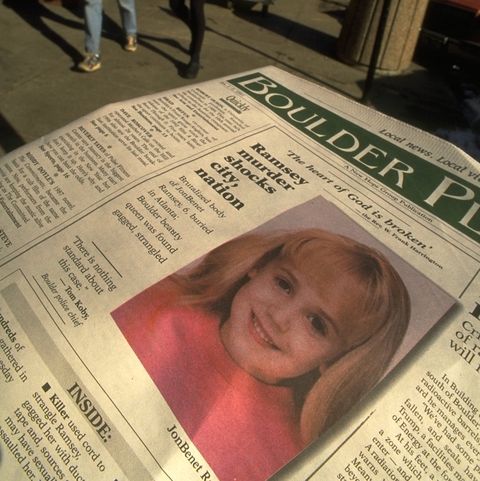
A newspaper page following the murder of JonBenet Ramsey.
JonBenet was captivated by Thumper’s talent performance, which featured a Patsy Cline classic titled “She’s Got You.” As a scorned lover, Thumper dramatically retrieved various items—love letters, records, and even a pair of junior golf clubs—from her evening gown. “JonBenet was fascinated and asked how I managed to fit everything in my dress,” Susan recalls.
“You looked up to Miss America. She had poise, she was beautiful. She was the ideal woman.”
Thumper and JonBenet quickly became friends and enjoyed playing together. The Gosneys found JonBenet to be sweet, gentle, and unaffected by the competitive nature of pageants. However, Thumper’s mother, Patsy Ramsey, while generally friendly, occasionally seemed distant. The Gosneys were intrigued by JonBenet’s monochromatic costumes, which contrasted sharply with the typically vibrant hues of most pageant dresses. When they inquired about her dressmaker, Patsy offered curt responses, as if she perceived them as trying to glean her secrets.
When JonBenet was tragically murdered, the Gosneys were left in shock. Thumper sent flowers to her little friend’s funeral, marking a poignant moment that changed everything.
Beauty pageants celebrating femininity have been a part of American culture since the 19th century, particularly flourishing at fairs and festivals. Their popularity surged in 1954 with the first televised Miss America pageant. Susan Gosney vividly recalls the moment her family first tuned in. “You looked up to Miss America,” she reminisces. “She embodied poise, beauty, and the ideal woman.”
As a result, young girls began dreaming of one day becoming Miss America themselves, leading to the inception of child pageants. The first locally televised children’s pageant, Little Miss Universe, aired in Miami in 1960, and by the 1980s, child pageants became staples in Southern culture, spreading through word of mouth without any formal advertising. Children participating in these events gained recognition within the pageant circuit, yet remained largely unknown outside of it.
“Pageants didn’t kill JonBenet. A terrible person did.”
Had it not been for JonBenet’s tragic murder, the world of child pageants might have continued to thrive quietly. Yet, in the wake of her death, media scrutiny intensified, leading to condemnation and even vilification of pageants. Americans were shocked by visuals of young girls in lavishly bejeweled dresses mimicking adult beauty queens. Amid rising concerns regarding child abuse, many perceived pageant children as robbed of their innocence by being trained to behave in sexually suggestive manners. Consequently, participation rates dwindled as newcomers shied away from contests. Simultaneously, pageant families found themselves besieged by reporters and subjected to harsh public judgment.
At a recent pageant in Dallas, Susan Gosney recounted an incident where a group of salesmen observed Thumper en route to the ballroom. One man loudly criticized, “It’s appalling that you force that poor child to wear makeup like that.” His comment struck deep.
“I’m not a pushy stage mother,” Susan defends. “My daughter genuinely enjoys these weekends, dressing up, and performing her talent routine … Pageants didn’t kill JonBenet,” she insists vehemently. “A terrible person did.”
Faye DeMatteo, mother of Rayanna, a past winner at Charm, shares her family’s struggles with persistent media attention. “We had to change our phone number twice to avoid reporters. I refused to engage with them,” she states, expressing outrage over comments made by Geraldo Rivera on his show: “He stated that when he sees a 6-year-old in a swimsuit, he sees sex. That’s his perception. When I see a 6-year-old in a swimsuit, I see just that—a 6-year-old.”
“People misunderstand pageant kids. They have good manners, high self-esteem and they know how to act in public.”
Many pageant mothers assert that media portrayals are distorted. They contend that the most vocal critics often lack firsthand experience with child beauty pageants. In response to televised discussions featuring psychologists and former Miss America contestants who spoke about potential emotional harm to pageant children, Faye and her fellow mothers mobilized. “We reached out to psychological institutions nationwide,” she recalls. “Even the Mayo Clinic couldn’t provide any studies. There’s no evidence to support claims of negative effects.”
Repeatedly, pageant mothers emphasize that their children willingly participate and are not subjected to the relentless perfectionism often seen in child actors or athletes. Indeed, children’s behavior during competitions can be charmingly unpredictable. “When Rayanna was just 3, she marched toward the judges, removed her shoes, and declared, ‘These shoes hurt,’ before setting them aside, finishing her routine, and blowing a kiss—yet she still took home the top title.”
Many regular participants liken pageants to charm schools of yesteryear. “People often misinterpret pageant kids,” argues Francis Clinton, grandmother of two competitors at Charm. “They exhibit good manners, possess high self-esteem, and know how to conduct themselves in public settings. You can observe a table of pageant kids dining quietly, while elsewhere, poorly behaved children can be seen.”
While pageants may be perceived as “politically incorrect,” as Faye mentions, they are also devoid of issues such as drug use, alcohol, and gang involvement. Additionally, she remarks, “There are far worse activities you could involve your child in than spending time with her.”
In the aftermath of JonBenet’s murder, some pageant families became increasingly concerned about their children’s safety. “Conversations in the elevator made me paranoid,” recalls Diana Pote, mother to contestant Alexandra. Although that anxiety has lessened, public comments persist. “One woman remarked about my daughter, ‘Oh, that poor baby.’ That infuriated me.” Such experiences have made pageant families more vigilant; now, mothers often remove their daughters’ makeup and hairstyles immediately after competitions. Moreover, the children have begun to keep their pageant activities a secret from classmates, sharing this aspect of their lives only with fellow competitors.
The Charm pageant registration kicks off on Friday around noon, with a line forming outside the Marriott ballroom. Faye DeMatteo, clad in a red-and-white polka dot outfit that coordinates with her daughter’s, warmly welcomes everyone while distributing Charm T-shirts.
Behind the registration desk sits Darlene Burgess, who co-founded Charm with her husband, Jerry, in 1982, inspired by their daughter Becky’s love for competition. Now, Becky is 27 and has a 4-year-old daughter who is also part of the pageant circuit. Darlene takes the time to engage with each applicant, providing guidance on which photographs to submit. “Not this one,” she advises a mother. “We no longer accept swimsuits, and her eyes appear shadowed.” With a warm demeanor and a charming Arkansan accent, Darlene exudes the comforting presence of a trusted family doctor. “This one’s a real standout,” she comments on a particular photo.
“I’ve seen people act uglier at Little League baseball games [than] at pageants.”
In 1997, Darlene and Jerry faced significant financial loss, reporting over $25,000 in losses as participant numbers plummeted from 200 to just 68. “We didn’t see any infants enter at all,” Darlene lamented. Another casualty of the changing landscape was Charm’s pageant book, which once boasted over 100 pages of advertisements from local businesses. In the years 1997 and 1998, only a handful of ads were sold. Although entrant numbers remain low, the Burgesses have made adjustments to their cash awards and anticipate breaking even.
Despite the negative publicity surrounding pageants, loyal families continue to support what they view as a wholesome family activity. Hugh Roberts, the proud grandfather of contestant Ashlee Golden, asserts, “I’ve witnessed worse behavior at Little League games than I ever have at pageants.”
However, participating in pageants comes with a hefty price tag: entry fees for Charm begin at $395, with additional costs for special categories like Portfolio and Talent. With multiple entries, families may spend over $1,000 just to participate. Moreover, pageant dresses can range from $300 to several thousand dollars each, while hairstyling and makeup for the two-and-a-half-day event can cost between $175 and $350. To prepare, many contestants also take modeling lessons with coaches, charging up to $85 per hour, with added expenses for makeup and hairstyling for photographs.
To offset these expenses, many pageant parents are also involved in related professions, such as hairdressing, makeup artistry, costume design, or coaching. Susan Gosney runs a store in Temple that sells cribs, children’s clothing, and pageant dresses; having been a dance instructor, she also coaches young contestants and designs dresses.
Since starting her pageant career, Thumper has accumulated over $20,000 in U.S. savings bonds. However, Susan prefers not to dwell on the financial outlay, feeling grateful that her husband doesn’t inquire about the costs.
<p class="body-dropcap css-tqc

Sienna Blake is a licensed aesthetic consultant and beauty writer specializing in cosmetic surgery advancements and non-invasive treatments. With a background in dermatology and over eight years of industry experience, Sienna is passionate about helping people achieve confidence through informed beauty decisions. She holds a Bachelor's degree in Health Sciences and regularly collaborates with top plastic surgeons to stay at the forefront of aesthetic innovations. Outside of her work, Sienna enjoys traveling, skincare research, and practicing Pilates.
