

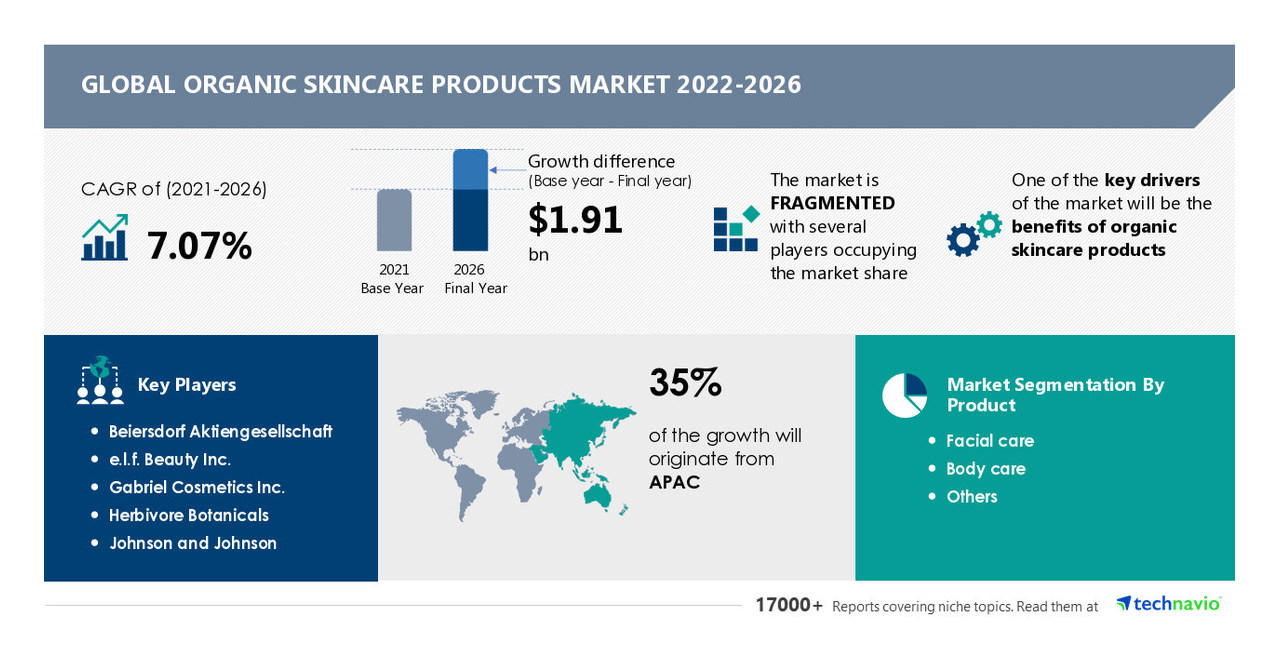
According to Technavio, the expansion of the organic skincare products market is significantly fueled by the advantages of organic skincare solutions.
Organic skincare products are crafted from natural components like plant extracts and essential oils, making them highly effective for addressing various skin concerns such as wrinkles, scars, and stretch marks. These products comply with stringent purity standards established by regulatory authorities across multiple countries, ensuring safety and quality. The notable benefits of these products are prompting consumers to transition from conventional synthetic skincare options to organic alternatives. Consequently, this shift in consumer preference is propelling the growth of the organic skincare market.
“The ongoing innovation and expansion of product portfolios aimed at premiumization, alongside increasing product awareness particularly among millennials, will further enhance market growth,” states an analyst at Technavio.
The global organic skincare products market is characterized by a fragmented landscape, comprising numerous international and regional vendors. These vendors prioritize critical elements including research and development, technology, and brand recognition to remain competitive in this thriving market. Significant investments in sourcing high-quality raw materials and focusing on product-related R&D are central to the development of advanced organic skincare solutions. Additionally, vendors are dedicated to building brand equity to distinguish themselves from their competition.
The global organic skincare products market experienced moderate labor deployment in the year 2021. Vendors differentiate themselves primarily through product quality and innovative features. They also provide a variety of products tailored to meet diverse consumer needs. The bargaining power of suppliers was deemed moderate in 2021, attributed to the availability of numerous international, regional, and local suppliers of raw materials. This situation is expected to persist until the end of 2026, with only a slight increase in supplier numbers. Furthermore, a key factor influencing market disruption is the rapid pace of technological advancements, with organic growth also playing a significant role due to continuous product innovation.
The report segments the market into the following categories:
- Product: Facial care, Body care, and Others
- Geography: North America, Europe, APAC, South America, and the Middle East and Africa
In terms of product segments, the facial care category is anticipated to generate the highest revenue within the market. This segment’s growth is propelled by increasing global awareness regarding the significance of a proper skincare routine. Additionally, the introduction of innovative products and the broadening of distribution channels are contributing factors to this segment’s upward trajectory.
Regionally, APAC is projected to dominate the market, capturing approximately 35% of the global market share. The growth within this region is driven by increased household income, a surge in demand for premium skincare products, and ongoing advancements in product offerings by leading market players.
The comprehensive report on the global organic skincare products market provides in-depth insights into potential business segments and regions that present lucrative opportunities for investment during the forecast period. We highly recommend reviewing our Sample PDF Report before making any purchasing decisions.
This report answers critical questions related to the organic skincare products market, including:
- Is the market structure fragmented or concentrated?
- What was the market size in 2021 and what are the forecasts for the organic skincare products market through 2026?
- Which product segments are best suited for investment during the forecast period?
- What is the market share of leading and strong vendors in the organic skincare products arena?
- What challenges are inhibiting growth, and what has been the impact of COVID-19 on the organic skincare market?
- What are the latest trends and regulatory frameworks affecting the organic skincare sector?
Have more questions? Speak to our analyst now
Users who purchased this report also showed interest in:
|
Scope of the Organic Skincare Products Market |
|
|
Report Coverage |
Details |
|
Page number |
120 |
|
Base year |
2021 |
|
Forecast period |
2022-2026 |
|
Growth momentum & CAGR |
Accelerate at a CAGR of 7.07% |
|
Market growth 2022-2026 |
USD 1.91 billion |
|
Market structure |
Fragmented |
|
YoY growth (%) |
4.83 |
|
Regional analysis |
North America, Europe, APAC, South America, and Middle East and Africa |
|
Performing market contribution |
APAC at 35% |
|
Key consumer countries |
US, Canada, China, Japan, Germany, and France |
|
Competitive landscape |
Leading companies, competitive strategies, consumer engagement scope |
|
Companies profiled |
Beiersdorf Aktiengesellschaft, e.l.f. Beauty Inc., Gabriel Cosmetics Inc., Herbivore Botanicals, Johnson and Johnson, Kose Corp., Laverana Digital GmbH and Co. KG, LOreal SA, Lush Retail Ltd., MAV Beauty Brands Inc., Milk Makeup, Miranda Kerr Pty Ltd., Natura and CO Holding S.A., Shiseido Co. Ltd, The Clorox Co., The Estee Lauder Co. Inc., The Procter and Gamble Co., True Botanicals Inc., Unilever PLC, and Weleda Group |
|
Market Dynamics |
Parent market analysis, Market growth inducers and obstacles, Fast-growing and slow-growing segment analysis, COVID 19 impact and future consumer dynamics, market condition analysis for the forecast period. |
|
Customization purview |
If our report has not included the data that you are looking for, you can reach out to our analysts and get segments customized. |
Table Of Contents:
1 Comprehensive Executive Summary of the Organic Skincare Market
- 1.1 Overview of the Market Dynamics
- Exhibit 01: Executive Summary – Chart on Market Overview
- Exhibit 02: Executive Summary – Data Table on Market Overview
- Exhibit 03: Executive Summary – Chart on Global Market Characteristics
- Exhibit 04: Executive Summary – Chart on Market by Geography
- Exhibit 05: Executive Summary – Chart on Market Segmentation by Product
- Exhibit 06: Executive Summary – Chart on Incremental Growth
- Exhibit 07: Executive Summary – Data Table on Incremental Growth
- Exhibit 08: Executive Summary – Chart on Vendor Market Positioning
2 In-Depth Market Landscape Analysis
- 2.1 Understanding the Market Ecosystem
- Exhibit 09: Parent market
- Exhibit 10: Market Characteristics
3 Comprehensive Market Sizing and Forecasting
- 3.1 Defining the Market Scope
- Exhibit 11: Offerings of vendors included in the market definition
- 3.2 Detailed Market Segment Analysis
- Exhibit 12: Market segments
- 3.4 Market Outlook: Forecast from 2021 to 2026
- Exhibit 13: Chart on Global – Market size and forecast 2021-2026 ($ million)
- Exhibit 14: Data Table on Global – Market size and forecast 2021-2026 ($ million)
- Exhibit 15: Chart on Global Market: Year-over-year growth 2021-2026 (%)
- Exhibit 16: Data Table on Global Market: Year-over-year growth 2021-2026 (%)
4 Comprehensive Five Forces Analysis of Market Dynamics
- 4.1 Summary of Five Forces Impact
- Exhibit 17: Five forces analysis – Comparison between 2021 and 2026
- 4.2 Analyzing the Bargaining Power of Buyers
- Exhibit 18: Chart on Bargaining power of buyers – Impact of key factors 2021 and 2026
- 4.3 Assessing the Bargaining Power of Suppliers
- Exhibit 19: Bargaining power of suppliers – Impact of key factors in 2021 and 2026
- 4.4 Understanding the Threat of New Entrants
- Exhibit 20: Threat of new entrants – Impact of key factors in 2021 and 2026
- 4.5 Evaluating the Threat of Substitutes
- Exhibit 21: Threat of substitutes – Impact of key factors in 2021 and 2026
- 4.6 Analyzing the Threat of Rivalry
- Exhibit 22: Threat of rivalry – Impact of key factors in 2021 and 2026
- 4.7 Overview of Market Conditions
- Exhibit 23: Chart on Market condition – Five forces 2021 and 2026
5 Product-Based Market Segmentation
- 5.1 Comprehensive Overview of Market Segments
- Exhibit 24: Chart on Product – Market share 2021-2026 (%)
- Exhibit 25: Data Table on Product – Market share 2021-2026 (%)
- 5.2 Comparison of Product Segments
- Exhibit 26: Chart on Comparison by Product
- Exhibit 27: Data Table on Comparison by Product
- 5.3 Facial Care – Market Size and Forecast from 2021 to 2026
- Exhibit 28: Chart on Facial care – Market size and forecast 2021-2026 ($ million)
- Exhibit 29: Data Table on Facial care – Market size and forecast 2021-2026 ($ million)
- Exhibit 30: Chart on Facial care – Year-over-year growth 2021-2026 (%)
- Exhibit 31: Data Table on Facial care – Year-over-year growth 2021-2026 (%)
- 5.4 Body Care – Market Size and Forecast from 2021 to 2026
- Exhibit 32: Chart on Body care – Market size and forecast 2021-2026 ($ million)
- Exhibit 33: Data Table on Body care – Market size and forecast 2021-2026 ($ million)
- Exhibit 34: Chart on Body care – Year-over-year growth 2021-2026 (%)
- Exhibit 35: Data Table on Body care – Year-over-year growth 2021-2026 (%)
- 5.5 Others – Market Size and Forecast from 2021 to 2026
- Exhibit 36: Chart on Others – Market size and forecast 2021-2026 ($ million)
- Exhibit 37: Data Table on Others – Market size and forecast 2021-2026 ($ million)
- Exhibit 38: Chart on Others – Year-over-year growth 2021-2026 (%)
- Exhibit 39: Data Table on Others – Year-over-year growth 2021-2026 (%)
- 5.6 Identifying Market Opportunities by Product
- Exhibit 40: Market opportunity by Product ($ million)
6 Understanding the Customer Landscape
- 6.1 Overview of Customer Landscape
- Exhibit 41: Analysis of price sensitivity, lifecycle, customer purchase basket, adoption rates, and purchase criteria
7 Comprehensive Geographic Landscape Analysis
- 7.1 Geographic Segmentation Overview
- Exhibit 42: Chart on Market share by geography 2021-2026 (%)
- Exhibit 43: Data Table on Market share by geography 2021-2026 (%)
- 7.2 Comparing Geographic Markets
- Exhibit 44: Chart on Geographic comparison
- Exhibit 45: Data Table on Geographic comparison
- 7.3 North America – Market Size and Forecast from 2021 to 2026
- Exhibit 46: Chart on North America – Market size and forecast 2021-2026 ($ million)
- Exhibit 47: Data Table on North America – Market size and forecast 2021-2026 ($ million)
- Exhibit 48: Chart on North America – Year-over-year growth 2021-2026 (%)
- Exhibit 49: Data Table on North America – Year-over-year growth 2021-2026 (%)
- 7.4 Europe – Market Size and Forecast from 2021 to 2026
- Exhibit 50: Chart on Europe – Market size and forecast 2021-2026 ($ million)
- Exhibit 51: Data Table on Europe – Market size and forecast 2021-2026 ($ million)
- Exhibit 52: Chart

Sienna Blake is a licensed aesthetic consultant and beauty writer specializing in cosmetic surgery advancements and non-invasive treatments. With a background in dermatology and over eight years of industry experience, Sienna is passionate about helping people achieve confidence through informed beauty decisions. She holds a Bachelor's degree in Health Sciences and regularly collaborates with top plastic surgeons to stay at the forefront of aesthetic innovations. Outside of her work, Sienna enjoys traveling, skincare research, and practicing Pilates.
