

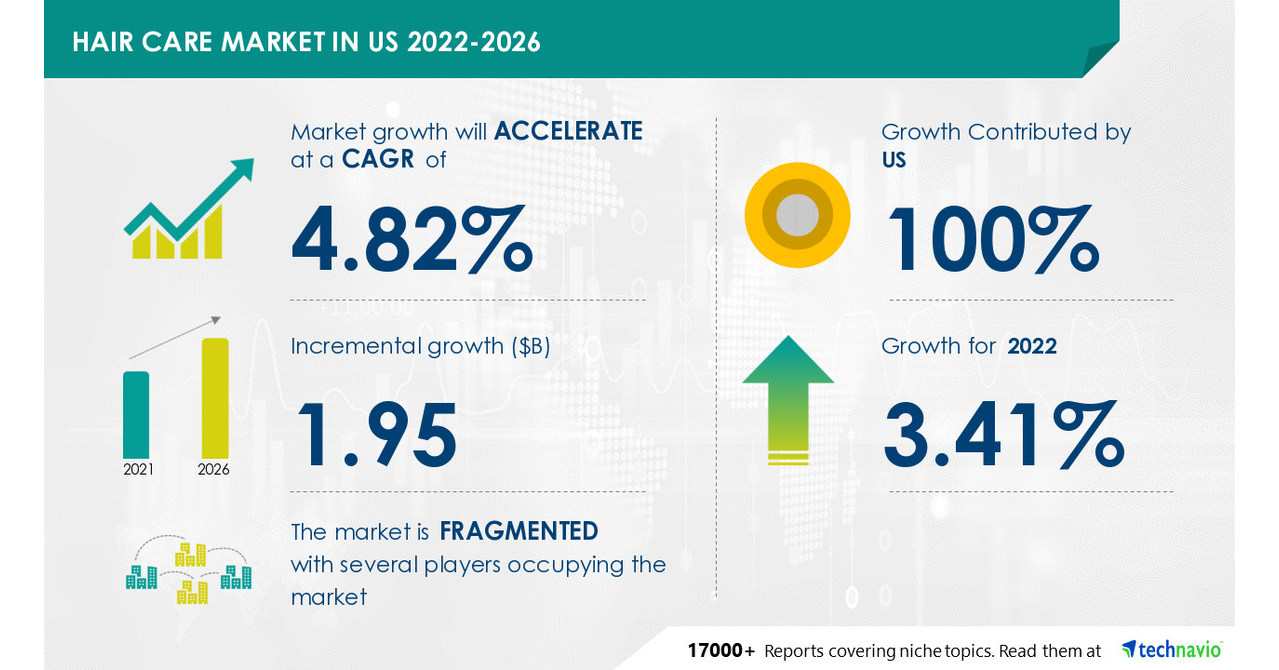
NEW YORK, Oct. 27, 2022 /PRNewswire/ — The hair care market in the United States is projected to experience substantial growth, with an anticipated increase of USD 1.95 billion between 2021 and 2026. According to the latest report from Technavio, the market is expected to accelerate at a compound annual growth rate (CAGR) of 4.82%. This growth is primarily attributed to the diverse range of hair colors and shades available to consumers. However, the proliferation of counterfeit products poses a significant challenge to the hair care industry in the US throughout the forecast period.
This report provides a comprehensive analysis of the current market scenario, highlighting the latest trends and driving forces, along with a thorough overview of the market environment. Access your FREE PDF Sample Report today!
In-Depth Vendor Analysis and Market Scope for Hair Care Products in the US (2022-2026)
To empower businesses in enhancing their market position, Technavio’s report delivers an extensive analysis of approximately 25 key vendors actively participating in the hair care sector. Prominent players in the US hair care market include Amway Corp., Beiersdorf AG, Amka Products Pty Ltd., Combe Inc., Coty Inc., Edgewell Personal Care Co., Grove Collaborative Inc., Henkel AG and Co. KGaA, Johnson and Johnson, Kao Corp, LOreal SA, LVMH Moet Hennessy Louis Vuitton SE, Natura and CO Holding SA, Newell Brands Inc., Revlon Inc, Shiseido Co. Ltd, The Avon Co., The Estee Lauder Co. Inc., The Procter and Gamble Co., and Unilever PLC. Below are key offerings from some of these leading vendors:
- Amway Corp. – This company offers an array of hair care solutions, including color repair shampoo, hair serum, and revitalizing hair masks under the Satinique brand, designed to cater to various hair needs.
- Coty Inc. – With a diverse portfolio, Coty provides hair care products like true color, advanced gray solution, basic white, beautiful collection, pro color kit, and flare me, which address a wide range of consumer preferences.
- Henkel AG and Co. KGaA – Through its subsidiary, Henkel offers a comprehensive range of hair care products, including hair color, hair gel, hair serum, dry shampoo, and styling cream, appealing to various consumer segments.
- Kao Corp – Known for its quality, Kao provides hair care items such as shampoo, conditioner, and dense hair masks under the Asience brand, focusing on restoring hair vitality.
- LOreal SA – A global leader in beauty, LOreal offers an extensive selection of hair care products including shampoo, conditioner, hair masks, hair serum, and purple shampoo, designed to meet diverse hair care requirements.
This report additionally encompasses the following critical areas:
Gain access to exclusive insights regarding key vendors, their strategies, and latest developments by purchasing the report.
Comprehensive Segmentation Analysis of the Hair Care Market in the US (2022-2026)
- Distribution Channel
- Offline: The offline segment is expected to be a vital contributor to market growth during the forecast period. This channel encompasses salons and spas, specialty stores, supermarkets, hypermarkets, department stores, medical clinics, and drugstores. Specialty retailers like Sephora and The Body Shop provide an enhanced shopping experience, offering premium beauty and personal care products that attract discerning consumers.
- Online
- Product
- Shampoo
- Hair Color
- Conditioner
- Other
Discover the contribution of each segment through concise infographics and detailed descriptions. Access a FREE PDF Sample Report now!
Key Highlights of the Hair Care Market in the US (2022-2026)
- CAGR of the market projected for the forecast period of 2022-2026
- In-depth analysis of the factors propelling hair care market growth in the US over the next five years
- Estimation of the hair care market size in the US and its contribution to the overall parent market
- Predictions regarding upcoming trends and shifts in consumer behavior
- Growth trajectory of the hair care market
- Thorough examination of the competitive landscape and detailed vendor insights
- Comprehensive information on challenges facing hair care market vendors in the US
Subscribe now to Technavio Insights for lifelong access. Our most popular “Basic Plan” is billed annually at USD 5000, giving you access to 100 reports and the ability to download 5 reports monthly!
Explore Related Reports for Broader Market Insights
Hair Styling Products Market in Europe by Product and Geography – Forecast and Analysis 2022-2026: Innovation and portfolio expansion aimed at product premiumization are significant factors driving this market. Vendors are increasingly focusing on research and development operations as customers seek hair styling products that can effectively address multiple hair-related issues in a short time.
Men’s Hair Care and Styling Products Market by Distribution Channel and Geography – Forecast and Analysis 2022-2026: The evolving fashion trends in hair styling significantly contribute to market growth, particularly among youth and millennials who are increasingly adopting personal grooming and fashion products. Manufacturers are developing user-friendly products that minimize hair damage.
|
Report Coverage |
Details |
|
Page number |
120 |
|
Base year |
2021 |
|
2022-2026 |
|
|
Growth momentum & CAGR |
Accelerate at a CAGR of 4.82% |
|
Market growth 2022-2026 |
USD 1.95 billion |
|
Market structure |
Fragmented |
|
YoY growth (%) |
3.41 |
|
Regional analysis |
US |
|
Competitive landscape |
Leading companies, competitive strategies, consumer engagement scope |
|
Amway Corp., Beiersdorf AG, Amka Products Pty Ltd., Combe Inc., Coty Inc., Edgewell Personal Care Co, Grove Collaborative Inc., Henkel AG and Co. KGaA, Johnson and Johnson, Kao Corp, LOreal SA, LVMH Moet Hennessy Louis Vuitton SE, Natura and CO Holding SA, Newell Brands Inc., Revlon Inc, Shiseido Co. Ltd, The Avon Co., The Estee Lauder Co. Inc., The Procter and Gamble Co., and Unilever PLC |
|
|
Market Dynamics |
Parent market analysis, market growth inducers and obstacles, fast-growing and slow-growing segment analysis, COVID-19 impact and future consumer dynamics, and market condition analysis for the forecast period. |
|
Customization purview |
If our report has not included the data that you are looking for, you can reach out to our analysts to get segments customized to your needs. |
Explore Our Comprehensive Consumer Staples Market Reports
Dive into the Table of Contents
1 Comprehensive Executive Summary
- 1.1 Overview of the Market Landscape
- Exhibit 01: Executive Summary – Chart on Market Overview
- Exhibit 02: Executive Summary – Data Table on Market Overview
- Exhibit 03: Executive Summary – Chart on Country Market Characteristics
- Exhibit 04: Executive Summary – Chart on Market Segmentation by Distribution Channel
- Exhibit 05: Executive Summary – Chart on Market Segmentation by Product
- Exhibit 06: Executive Summary – Chart on Vendor Market Positioning
2 Analyzing the Market Landscape
- 2.1 Understanding the Market Ecosystem
- Exhibit 07: Parent Market Insights
- Exhibit 08: Market Characteristics Overview
3 Detailed Market Sizing
- 3.1 Defining the Market
- Exhibit 09: Offerings of Vendors Included in the Market Definition
- 3.2 Analyzing Market Segments
- Exhibit 10: Breakdown of Market Segments
- 3.4 Market Outlook: Projections for 2021-2026
- Exhibit 11: Chart on US – Market Size and Forecast 2021-2026 ($ million)
- Exhibit 12: Data Table on US – Market Size and Forecast 2021-2026 ($ million)
- Exhibit 13: Chart on US: Year-over-Year Growth 2021-2026 (%)
- Exhibit 14: Data Table on US: Year-over-Year Growth 2021-2026 (%)
4 Comprehensive Five Forces Analysis
- 4.1 Summary of Market Forces
- Exhibit 15: Five Forces Analysis – Comparison between 2021 and 2026
- 4.2 Buyer Bargaining Power Insights
- Exhibit 16: Chart on Buyer Bargaining Power – Impact of Key Factors 2021 and 2026
- 4.3 Supplier Bargaining Power Trends
- Exhibit 17: Supplier Bargaining Power – Impact of Key Factors in 2021 and 2026
- 4.4 Analyzing Threats from New Entrants
- Exhibit 18: Threat of New Entrants – Impact of Key Factors in 2021 and 2026
- 4.5 Evaluating Threats of Substitutes
- Exhibit 19: Threat of Substitutes – Impact of Key Factors in 2021 and 2026
- 4.6 Analyzing Rivalry Threats
- Exhibit 20: Threat of Rivalry – Impact of Key Factors in 2021 and 2026
- 4.7 Current Market Conditions Analysis
- Exhibit 21: Chart on Market Condition – Five Forces 2021 and 2026
5 Market Segmentation Insights by Distribution Channel
- 5.1 Breakdown of Market Segments
- Exhibit 22: Chart on Distribution Channel – Market Share 2021-2026 (%)
- Exhibit 23: Data Table on Distribution Channel – Market Share 2021-2026 (%)
- 5.2 Comparison by Distribution Channel
- Exhibit 24: Chart on Comparison by Distribution Channel
- Exhibit 25: Data Table on Comparison by Distribution Channel
- 5.3 Offline Market Size and Forecast 2021-2026
- Exhibit 26: Chart on Offline – Market Size and Forecast 2021-2026 ($ million)
- Exhibit 27: Data Table on Offline – Market Size and Forecast 2021-2026 ($ million)
- Exhibit 28: Chart on Offline – Year-over-Year Growth 2021-2026 (%)
- Exhibit 29: Data Table on Offline – Year-over-Year Growth 2021-2026 (%)
- 5.4 Online Market Size and Forecast 2021-2026
- Exhibit 30: Chart on Online – Market Size and Forecast 2021-2026 ($ million)
- Exhibit 31: Data Table on Online – Market Size and Forecast 2021-2026 ($ million)
- Exhibit 32: Chart on Online – Year-over-Year Growth 2021-2026 (%)
- Exhibit 33: Data Table on Online – Year-over-Year Growth 2021-2026 (%)
- 5.5 Market Opportunities

Sienna Blake is a licensed aesthetic consultant and beauty writer specializing in cosmetic surgery advancements and non-invasive treatments. With a background in dermatology and over eight years of industry experience, Sienna is passionate about helping people achieve confidence through informed beauty decisions. She holds a Bachelor's degree in Health Sciences and regularly collaborates with top plastic surgeons to stay at the forefront of aesthetic innovations. Outside of her work, Sienna enjoys traveling, skincare research, and practicing Pilates.