


[ad_1]
SINGAPORE – Seniors who have mobility issues or are housebound will have access to dental healthcare through a programme where a dentist visits them at the nursing home or at their own homes once, and nurses drop by for regular check-ups.
The Tele-Dentistry Oral Care for Seniors (T-Docs) programme, which was piloted in early 2021, is in addition to other health check-ups the seniors receive.
The joint initiative by the National Dental Centre Singapore (NDCS) and Temasek Foundation leverages technology to provide regular screening and monitoring of seniors’ oral health, which they said enables early detection of oral diseases and ensures preventive care for seniors.
Clinical Associate Professor Christina Sim, principal investigator at T-Docs, said: “This enables early detection of oral diseases and fills the crucial gap in preventive oral care for our vulnerable seniors, of which dental issues were found among 80 per cent of about 200 seniors recruited for the pilot T-Docs programme.”
The dental issues include tooth decay and periodontal disease, which refers to gum infections.
A 2017 study found that 31 per cent of seniors in Singapore were found to be edentulous or using dentures, and 38 per cent had fewer than 20 natural teeth.
Professor Sim, who is a senior consultant at the NDCS, added:. “This new model of care provides timely oral care to seniors, convenience to caregivers and our partners, and optimises resources for better community care.”
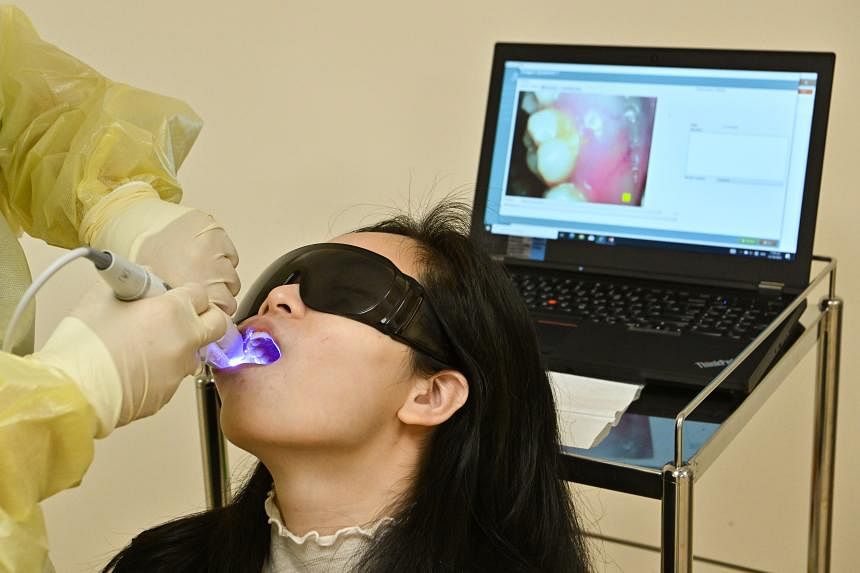
More than 40 nurses in nursing homes here and members of St. Andrew’s Community Hospital (SACH) homecare team have been trained to perform oral health screenings with intra-oral imaging of seniors’ oral cavities and provide basic oral and denture hygiene care.
Seniors are first examined by a dentist. They are then regularly screened and monitored every six months by trained staff from SACH and Vanguard Healthcare, which operates eldercare facilities, using an intra-oral camera with fluorescence technology.
Early signs of tooth decay and gum inflammation can be detected with the use of the intra-oral camera that is placed in the patient’s mouth. The camera is also able to differentiate between existing and newly formed dental plaque.
Following the check-up, the intra-oral scans and medical information are uploaded to an electronic system from which NDCS dentists receive the patients’ records, and recommend treatment plans that will be relayed back to SACH and Vanguard Healthcare staff for follow-up.
Many of the 199 seniors involved in the pilot programme were attended to by nurses and staff who already regularly visit them for health checkups.
[ad_2]
Source link