


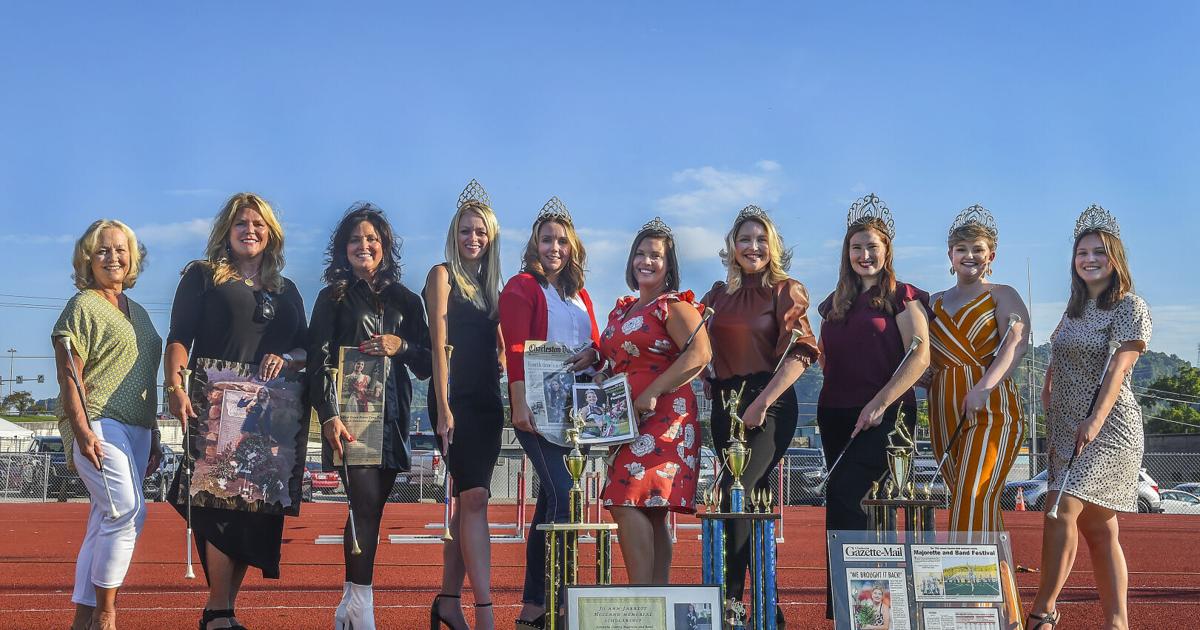
Reflecting on the past 75 years in Kanawha County, it’s evident that many traditions have faced decline or even extinction. This trend has notably affected high school marching bands, which were once vibrant hubs of community spirit.
“Back in my teaching days, it was quite common to oversee a band of 100 members,” recalled Nick Munoz, who was the band director at Herbert Hoover High from 1976 to 1982.
“Today, if you can gather 50 musicians, you’re considered one of the larger bands,” he added, highlighting the significant decrease in participation.
Several entire high schools along with their bands have disappeared, including notable institutions like Charleston, DuPont, and Stonewall Jackson. Even 75 years ago, schools such as Clendenin and Elkview had not yet merged to form Hoover.
This historical reflection also sheds light on the evolving societal perceptions regarding women and girls in the realm of performing arts. Once celebrated were majorettes, the talented baton twirlers who graced the bands and participated in annual beauty contests in Kanawha.
“During my tenure at Hoover, being a majorette was regarded as the pinnacle of achievement for girls,” Munoz reminisced.
“Joining the majorette corps was highly competitive,” noted Janie Coffman Bailey, who was a majorette in the late 1960s at Sissonville High.
“We had around 12 majorettes,” added Kimberly O’Connor, a majorette from South Charleston High in the early ’80s. “Every school had a similar number.”
Today, however, these groups have largely vanished. Current Hoover band director Meleah Fisher remarked that having a majorette corps is now considered “an oddity.”
“Once, it was unusual if you didn’t have them,” she reflected.
Both Munoz and Mark Hardman, the band director at George Washington High, attribute much of the decline in band sizes to Title IX, the federal legislation that has expanded athletic opportunities for girls.
Hardman observed that when he was growing up, bands consisted of three girls for every boy. Outside of band, girls had limited options, mainly cheerleading or perhaps joining a volleyball team.
Fisher pointed out a notable increase in the variety of activities available to students beyond just band.
“Who could have predicted that we’d have archery teams competing at the national level?” she questioned.
Despite enduring years of population declines, shifting band demographics, and evolving cultural norms, the legacy of Kanawha bands and the majorettes continues to thrive.
Celebrating its 75th anniversary, the Gazette-Mail Kanawha County Majorette & Band Festival continues to be a cherished event, having been held annually since 1947, except during the 2020 pandemic.
“The kids then deserved community support, just as the kids today deserve it,” said Mark Davis, the fine arts curriculum director for Kanawha public schools. “We hope the community shows up to support them.”
Band directors emphasize that the 6:30 p.m. showdown at Laidley Field serves as a crucial fundraiser, particularly as they work to recover from the pandemic’s impact.
“Funding is essential for purchasing instruments and organizing trips, among other expenses,” Hardman explained. “We all welcome that financial assistance.”
He added, “It’s exciting to have a county championship to rally around.”
Munoz, who has attended nearly all of these events over the past 50 years, summarized it well:
“Celebrating 75 years of anything is quite significant.”
Transforming the Nature of the Competition
It’s been a remarkable journey since MGM Studios “exploitation representative” J.E. Watson crowned the first Miss Kanawha Majorette, the dazzling 16-year-old Dolores Thompson, as reported by the Charleston Daily Mail.
Amidst 74 contestants, Watson’s career at the time was already double Thompson’s age.
“Mr. Watson faced one of the toughest tasks in his 32 years in the entertainment industry,” the newspaper highlighted. “He made his final selections only after recalling nearly a dozen beauties to the stage for his ultimate decision.”
Notably, this beauty pageant featured live music. The conductor for the now-consolidated Charleston High described it as “the greatest thrill of my musical career.”
With an estimated 25,000 attendees, the event even caused traffic congestion that prevented the school superintendent from delivering roses to Thompson, dubbed the “American Beauty.”
O’Connor, who was crowned Miss Kanawha Majorette in 1983, recalled having a male soap opera star as one of her judges.
While she focused on her twirling routine, she felt honored to receive the title of Miss Kanawha Majorette.
“It was a truly special honor,” O’Connor reflected.
Stevi Steele, crowned Miss Kanawha Majorette in 2006 and also the first-place twirler that year, shared that being a majorette was a family tradition for her.
“We always made it a point to watch the majorettes perform together,” Steele said, recalling her winning of the title as a dream realized.
“I was determined to savor every moment,” Steele recounted. “I had practiced and fantasized about winning this title throughout my childhood.”
She humorously noted, “It was almost like I manifested my win.”
The event has evolved in name and focus over the years. The merger that created this newspaper absorbed the sponsoring Daily Mail. The term “band” was incorporated as the band competition gained prominence, while the focus on majorettes diminished.
“For many years, the bands were not judged at all,” Munoz pointed out.
“Initially, bands merely performed for the majorettes to twirl to,” he clarified.
Munoz advocated for a more contemporary band competition in the 1970s but faced resistance from the festival’s organizers.
“I was told that no one came to see the bands,” Munoz recalled, reflecting the challenging dynamics of the time.
Fisher, who has been the Hoover band director for over 22 years, noted differences even from her time as a band student between 1985 and 1987.
“Back then, you could move during your opening song, had to remain still for the subsequent pieces, and then could move again for the final song,” Fisher explained.
She also noted that judges were positioned at ground level, making it difficult for them to appreciate the intricate formations of today’s bands.
In another evolution, the marching bands from West Virginia University or Marshall University now perform following the high school competitions.
“All the band directors have at least one child in the WVU band,” Fisher noted of this year’s college performers, emphasizing the significance of this homecoming performance.
Thus, it has transformed into more than a beauty pageant accompanied by music.
As the number of majorettes has dwindled, they have largely become synonymous with “feature twirlers,” who compete for the title of Miss Kanawha Majorette and in other categories.
Rich Brooks, the Nitro High band director since 2002, expressed a preference for a flag corps over traditional majorettes, advocating for their visual appeal.
Both he and Fisher concurred that flags offer a more vibrant display than the classic majorette batons.
“When you’re viewing a performance on a football field, a baton that’s just three-quarters of an inch thick lacks the visual impact of a colorful flag ranging from 3 to 8 feet,” Fisher noted.
Hardman, who has led George Washington High since 1997, reminisced about the era when fire batons were all the rage before the advent of artificial turf.
Over the years, the festival has also seen the decline of “originality” or “novelty” routines, which featured props, elaborate sets, and dancing majorettes.
“These performances were unique to our event,” Hardman acknowledged.
“Most band directors were relieved when that aspect faded, as it required immense effort for just a single evening,” he shared.
Brooks mentioned that bands typically stood still to perform for these routines.
“I’m honestly glad that’s no longer the case,” Brooks admitted. “Coordinating that alongside your marching band competition show was quite a hassle.”
However, Bailey, the 1968 Miss Kanawha Majorette, stated, “The originality routines were once spectacular.”
She recalled her Sissonville High group’s performance being themed around another iconic Charleston event, the Sternwheel Regatta, which has seen its own rise and fall over the years.
“We had a stunning steamboat backdrop,” Bailey said with nostalgia.
“We emerged dressed as Southern belles, twirling our large parasols around,” she vividly remembered.
In a more controversial performance, the 1982 East Bank High majorettes performed a routine inspired by Playboy Bunnies, as detailed by Bob Greene, a contributing editor for Esquire. Greene, who was asked to judge that year’s 99 contestants based primarily on their looks, described the performance as the band played “Centerfold.”
“Regardless of the appropriateness of selecting a beauty queen in the 1980s, it underscored the dedication these West Virginia teenagers displayed in participating in this experience,” Greene articulated.
The Resilience of Twirlers and Their Legacy
Despite the many transformations, the festival has endured. It has outlasted high schools that once competed, political shifts in the state legislature, and even the reign of Queen Elizabeth II.
Former Miss Kanawha Majorettes reflect on their experiences as some of the most cherished moments of their youth.
Shannon Snodgrass, a city councilwoman who was crowned Miss Kanawha Majorette in 1980 while attending the now-defunct DuPont High, fondly recalled receiving flowers from the governor.
Mandy Pellegrin, who held the title in 2004, described it as “the best moment ever as a teenager.”
“After three years of hard work, I finally secured the title in my senior year,” Pellegrin shared, reflecting on her dedication.
By 2004, she noted, “The competition had evolved beyond being merely a beauty contest.” She also clinched the first place feature twirler award that night, a title she aspired for more than the majorette crown.
“I was determined to showcase my skills and tackle the challenging routines,” Pellegrin emphasized.
Her school, Riverside High, born from the consolidation of previous competitors, also triumphed in the now-defunct originality category.
Pellegrin expressed that she made lifelong friends, some of whom would become her bridesmaids, through band.
“Witnessing the decline of these programs is incredibly disheartening,” she lamented. “It was everything to me, and now it’s nearly gone.”
For the upcoming event, band sizes range from 27 students at Hoover to 54 each at St. Albans and Nitro high schools. Hardman’s 29-member band at George Washington has no feature twirler competing for the Miss Kanawha Majorette title.
Additionally, he noted a lack of other auxiliary members such as color guards or twirlers.
“We’re operating on a barebones setup,” he explained. “Our focus is solely on marching and playing.”
He believes his band is experiencing a pandemic-induced low but also acknowledges a gradual decline in numbers, though not in quality.
On the other hand, Brooks noted that Nitro had around 70-75 band members prior to the pandemic.
Gabbie Mullins, the 2018 Miss Kanawha Majorette, shared that Riverside High had revived a majorette line during her four years, but it has since ended.
“It feels like there’s little interest in twirling anymore in the Kanawha Valley,” Mullins observed.
Bailey expressed her elation upon winning the title of Miss Kanawha Majorette in 1968. A national field director from the Miss America Pageant judged her alongside over 100 competitors. In accordance with tradition, her bandmates carried her off the field on a bass drum.
“Even today, people still remember that moment,” she said fondly.
“Back then, being a majorette was a significant achievement. Now, I’m always amazed by the talent of today’s twirlers,” she noted.
The current feature twirlers embody the modern essence of majorettes, but they too could potentially fade away.
“Everyone seems to be striving to emulate DCI [Drum Corps International] bands,” Mullins remarked. “That’s the prevailing trend. Traditional bands with majorettes seem to be losing appeal.”
She is currently part of the West Virginia Mountainettes, a traveling twirling group seeking new members, expressing her desire to promote twirling in the area.
The Majorette & Band Festival has played a crucial role in preserving this cherished tradition. Carrie Long reminisced about watching the festival as a child before ultimately winning the title of Miss Kanawha Majorette in 2016.
“I could see my grandma tearing up from the stands, knowing I practiced for hours outside her house to reach this moment,” Long reflected.
The reigning winner traditionally crowns her successor, which was Long who crowned Lauren Carnell from Capital High. Carnell noted that her sister, Olivia, a previous winner in 2014, was in attendance as well.
“Carrie brought the beautiful crown, and suddenly I was overcome with emotion,” Carnell recalled. “Having seen my sister and others perform at this event since childhood, it was incredibly meaningful.”
“Today’s twirlers work tirelessly,” Bailey commented. “It takes countless hours of dedication to excel.”
However, outdated perceptions of majorettes may still linger.
During Bailey’s phone interview, her husband, Jim, interjected, suggesting that majorettes provided entertainment when the football teams underperformed.
“That’s a man’s perspective,” she retorted, highlighting the evolving views on the role of majorettes in modern times.