

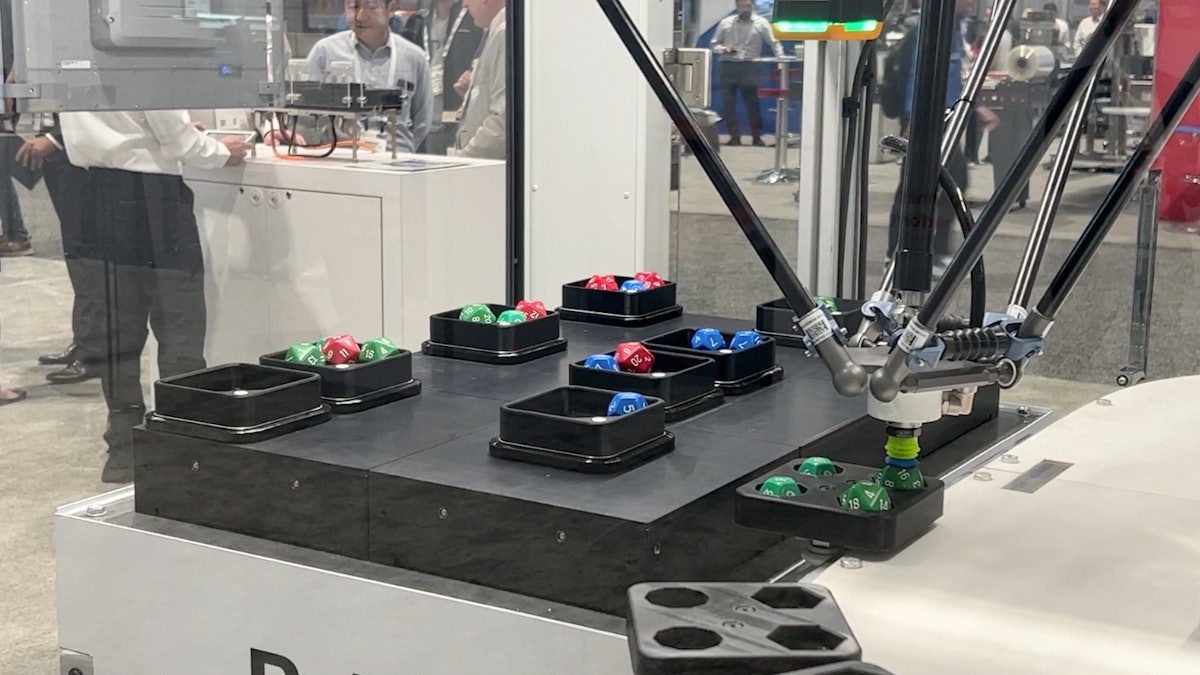
October 2022’s PACK EXPO International in Chicago marked my first visit to a major PMMI tradeshow since the onset of the COVID-19 pandemic. The lengthy hiatus heightened my curiosity about the latest developments in the cosmetics and beauty care industry. Given the challenges posed by the pandemic—such as factory access limitations, a shortage of skilled technicians, and escalating labor costs—I eagerly navigated the show floor. After extensive exploration and countless inquiries, I identified three pivotal themes that dominated the event: sustainability in packaging materials, automation advancements, and the digitization of industry processes.
While many discussions on sustainability centered around food and high-volume consumer products, the cosmetics and beauty care sectors also grapple with this crucial topic. However, this article will primarily delve into the realms of automation and equipment technology. I was particularly impressed by the increasing integration of digitalization across processes, including how the Internet is utilized to address equipment challenges and facilitate communication.
Revolutionizing Production with Smart Automation and Linear Motor Track Systems
Numerous automation suppliers showcased innovative, integrated smart automation solutions that enhance both machine and plant processes. My observations highlighted three leading companies: Beckhoff, ABB’s B&R, and Schneider Electric. These organizations are paving the way in the automation sector, emphasizing the transition from traditional hard automation to more sophisticated systems.
Central to this evolution are linear motor tracks that utilize magnetic carriers—often referred to as shuttles—in conjunction with robots, cobots, and integrated control systems. These advanced package holders transport workpieces with exceptional precision and flexibility, enabling on-demand operations without rigid timing constraints. Many automation companies, including Schubert, Syntegon Technology, Groninger, PKB, and Weckerle, have adopted systems like Beckhoff’s eXtended Transport System (XTS) and B&R’s ACOPOStrak and SuperTrak into their cosmetic and beauty care production lines.
The benefits of these advancements are multifaceted, offering higher operating speeds, precise braking, and acceleration, with each product’s movement controlled independently of others. This not only reduces the need for buffer zones but also significantly enhances product aesthetics, which is vital in the cosmetics sector. By minimizing rough handling and contact between package components, such systems help maintain the product’s integrity. Their modular design also allows for easy scaling and reconfiguration, thereby optimizing investment and resource allocation. Beckhoff displayed dazzling movement of the carriers on the XPlanar table.
The most exciting innovations I encountered at the show were the levitating 2D product transport systems such as the XPlanar system from Beckhoff and ACOPOS 6D from B&R. These revolutionary technologies employ the principles of magnetic levitation, where shuttles equipped with integrated permanent magnets hover above surfaces composed of electromagnetic motor segments. This innovative design allows movement in two-dimensional space while offering rotation and tilt along three axes, enabling precise control over the height of levitation. Collectively, these features provide a remarkable six degrees of motion control freedom. By eliminating dirt caused by mechanical abrasion—often a concern with traditional conveyor systems—this technology prevents contamination of sensitive products and reduces cleaning costs, enhancing overall operational efficiency.
I am eagerly looking forward to witnessing the implementation of compact assembly lines utilizing this cutting-edge levitating transport technology.
Collaborative Robots Transforming Labor Dynamics in Manufacturing
The trend of integrating cobots—or Collaborative Robots—into manufacturing processes was unmistakable at PACK EXPO International. These robotic arms, equipped with pressure-sensitive sensors, are designed to work safely alongside human operators, eliminating the necessity for costly industrial guards and safety scanners. Cobots are particularly adept at automating tasks such as box and case forming, case packing, and palletizing, especially in scenarios where high-speed automation is not the primary requirement.
Flexline Automation showcased its BoxEZ manual case former, effectively integrating it with Universal Robots cobots. Additionally, they demonstrated another cell featuring an extra cobot that automated the collation and insertion of primary products into formed boxes before pushing them through case closers and tapers. This not only streamlines operations but also enhances productivity.
Meanwhile, Omega Design Corporation presented its Cobot Pack Assist for the Intelli-Pac unit, which facilitates the loading of multiple containers into a formed box. This system supports track and trace case packing, labeling, and inspection processes. Omega claims that this cobot significantly boosts efficiency by operating faster than manual case packing, reducing the likelihood of human error and allowing operators to focus on overall operational quality rather than repetitive hand motions. 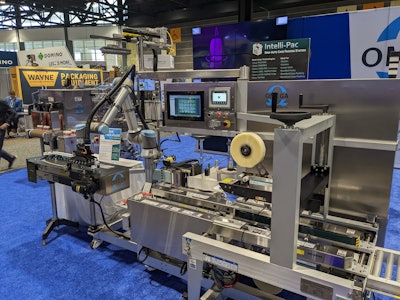 Omega Design Corporation exhibited its Cobot Pack Assist for the Intelli-Pac unit, loading multiple containers into a formed box.
Additionally, Brooks Automation showcased its SCARA-type PreciseFlex Collaborative Robots in a palletizing setup. These SCARA cobots are particularly noted for their simplicity and their ability to reach both horizontally and vertically, enhancing operational efficiency.
Enhancing Customization in Packaging with Late-Stage Printing Technologies
Effective late-stage customization relies heavily on high-quality, on-demand printing directly onto secondary and tertiary packaging. This capability not only reduces costs by eliminating the need for pre-printed labels or boxes but also supports sustainability efforts by minimizing waste. Moreover, it alleviates supply chain disruptions for both manufacturers and fulfillment centers. The ability to print right before shipping or picking presents unique opportunities for brands to personalize packaging for individual consumers, serving as a powerful marketing tool. Imagine receiving a box adorned with colorful images of the products inside or suggestions for complementary items that might enhance your purchase!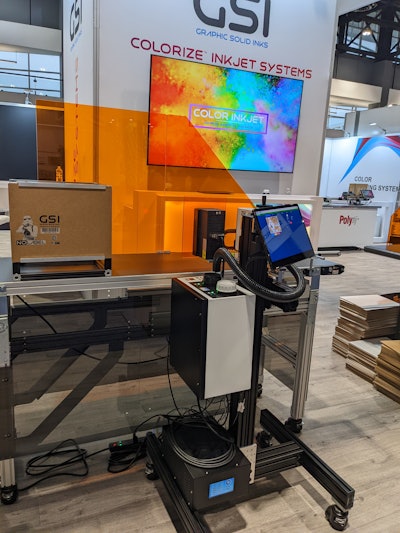 Launched at PACK EXPO Las Vegas last year, the GSI Colorize Inkjet System made its Chicago debut, and impressed cosmetics packaging expert David Hoenig.
Recent advancements in inkjet technology have been remarkable, with a variety of inks—ranging from non-hazardous vegetable oils to UV-cured options—available for application on various package substrates. Most inkjet systems utilize continuous inkjet printing (CIJ) and drop-on-demand (DOD) technologies, employing piezoelectric technology (PIJ) to control ink flow. Suppliers consistently enhance their products to boost reliability, maintainability, resolution, readability, and compliance with GS1 standards, including GS1-128 and GTIN-14. A growing trend among suppliers is the integration of scanning software to verify the accuracy and readability of printed codes. Moreover, the incorporation of Industry 4.0 elements—some even venturing into Industry 5.0—enables connectivity with factory ERP systems and other equipment, along with continuous equipment monitoring via cloud integration. The interaction with track and trace software is becoming increasingly popular, particularly for the pharmaceutical sector, but is also applicable for high-value cosmetics and skin care products to monitor and detect product diversion. Additionally, advancements in printing capabilities are supported by large, high-resolution printing heads.
One notable introduction was from Domino, presenting its new Domino Cx350i, a high-resolution DOD case-coding system. The company emphasizes the system’s high resolution, maintenance-free features, and user-friendly control interface.
Graphic Solid Inks (GSI) made an impressive debut at PACK EXPO International Chicago with its multi-color Colorize Inkjet Systems, featuring CMYK+White CIJ with UV-cured inks. GSI has combined NoLabel and Colorize printing heads into a single control system, enabling vivid, high-resolution printing along with barcodes on kraft corrugated materials. Previous coverage of this innovative technology highlighted its potential impact specifically on the cosmetics and beauty care sectors.
Additionally, Diagraph showcased its DOD ResMark 5000 high-resolution compact heads, which eliminate the need for ink hoses and feature integrated control for up to eight heads, patented quick-disconnect printer modules for easy swaps, and localized wireless connectivity. The company also claims to have the industry-leading ink throw distance of up to 0.5 inches.
In response to the advancements in inkjet coding, the laser coding market has also made significant strides since my last attendance at PACK EXPO International. A variety of UV wavelengths and powerful CO2 options are now available, enabling clear markings on more substrates, including metals, which can be effectively scanned by various hardware and software solutions. The etching envelope has also expanded considerably.
For instance, Videojet showcased its 60-Watt CO2 Laser Marking System, featuring an etching envelope of nearly 4 square feet and a lifespan of 45,000 hours, demonstrating substantial savings in ink consumption.
Another critical aspect of late-stage customization is the ability to print or code primary packages without the need for pre-printed materials. This flexibility is especially beneficial for short runs or promotional customizations, which are common in the cosmetics and beauty care industry. The technological challenge lies in ensuring that equipment can accommodate a wide range of formats with minimal changeovers.
HSAUSA introduced the VFS-1000 Vertical Feeding System, presenting a unique method for managing how folding cartons, bags, and pouches are magazined and delivered to a conveyor. In this system, stand-up folding cartons, pouches, and bags are oriented on their edges, picked, and placed onto a shuttle table before being transferred to the downstream conveyor—presumably for printing or labeling. While this represents a batch operation, replenishing the blanks can occur without halting the equipment. The VFS-1000 is part of a modular family capable of automatically handling, printing (or labeling), inspecting, rejecting, and stacking finished products. 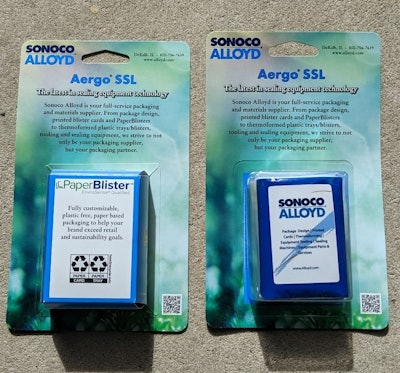 Sonoco Alloyd has been touting their EnviroSense PaperBlister package as a way to contribute to a brand’s sustainability profile.
Blister packaging is a common solution for late-stage customization within the cosmetics sector. Sonoco Alloyd introduced its Aergo line of blister sealing packaging equipment, which features advanced heat, fusion, and RF sealing technologies. The equipment employs servo motions instead of mechanical ones, significantly enhancing denesting capabilities while allowing for scalability through additional options. The Aergo SSL 11 station servo-driven machine showcased at the event was fully equipped to handle both plastic blisters and EnviroSense PaperBlisters, featuring Alloyd’s quick-change heat seal tooling, which streamlines operations. Sonoco Alloyd’s EnviroSense PaperBlister has been promoted as a sustainable packaging solution to enhance a brand’s eco-friendly profile.
Most containers within the cosmetics and beauty care sectors are sourced internationally. To safeguard the purity of the contents between the container’s production and its filling process, some manufacturers have opted to deliver pre-capped containers to their filling operations. This strategy prevents dust and dirt from contaminating the product. Consequently, the filling systems must be capable of removing the caps, placing them onto a shuttle system, filling the containers, and then re-capping and re-torquing them. Although this process complicates the filling equipment, it offers significant operational advantages, including the elimination of cumbersome equipment disassembly during changeovers and minimizing physical handling of caps, thereby preserving their aesthetic integrity. Filamatic introduced an inline simplex filler (one filling nozzle) equipped with this capability.
PKB has also begun offering this uncapping, filling, and recapping feature. For example, I observed a video at the PKB booth showcasing a high-speed filler performing these tasks seamlessly.
Numerous suppliers highlighted the importance of remote access for equipment troubleshooting, utilizing the Internet, with many leveraging smartphones as communication tools.
NITA showcased its extensive range of SENTIANT labelers, emphasizing uptime, seamless remote monitoring, and maintenance access through cloud systems. NITA claims that its labelers are among the easiest to maintain, featuring 100% license-free, non-proprietary electronics and software, synchronized servos (eliminating the need for PLCs), live tech support via the Internet, self-diagnosing software systems with in-screen parts ordering, and built-in preventative maintenance capabilities.
Innovative Equipment Solutions for Tube Packaging in the Cosmetics Sector
In the cosmetics, body, and hair care industries, tubes represent a prevalent packaging format, available in various sizes and decorative artworks. To enhance manufacturing efficiency, one effective approach is achieving easy and fast changeovers.
Citus-Kalix, part of the COESIA Group, introduced its latest high-speed simplex (one filling nozzle) KX1103 EVO tube filler, designed for both plastic and metal tubes, with a remarkable production capacity of 110 tubes per minute. The manufacturer markets this machine as “the next generation,” primarily due to its quick changeover capabilities, boasting a changeover time of just 10 minutes to initiate a new production run. This efficiency is achieved through automatic servo-driven adjustments, registered format setup data in recipes, dedicated change parts that can be easily swapped without adjustments or tools, and increasingly, step-by-step instructions displayed on the HMI.
Traditionally, tubes for cosmetics and beauty care have been sourced from China. However, disruptions in the supply chain due to COVID-19 have sparked demand for innovative tube labeling equipment. Pendergraph Machines unveiled its tube pre-labeler TL-60, designed to integrate with a Prosys RT60 tube filler. The machine offers left- and right-hand configurations, allowing compatibility with various tube filler models. It features quick-change spindle tooling and recipe-based programs, capable of labeling 5/8-in. diameter tubes up to 2.25-in. in diameter and 3-in. to 8-in. in length. Operating at speeds of up to 70 tubes per minute, this labeling machine enables manufacturers to pre-label blank tubes or over-label decorated tubes, thus reducing the need to order various pre-decorated artwork tubes. Importantly, plastic tubes and labels can be recycled together, aligning with sustainability goals.
Advancements in Conveyor Systems for Cosmetic Packaging
While several equipment trends observed at the show leaned towards more linear servo or magnetic movers and shuttles, conveyor systems remain a fundamental component of most packaging lines. No modern conveyor system is truly complete unless it can efficiently manage multiple product types without experiencing jams or requiring lengthy changeovers.
Advanced Manufacturing Technology is now offering pressure-calibrated adjustable rail systems, which serve as hardware for others to upgrade their conveyor systems. This system relies on precisely calibrated extensions of pneumatically energized, spring-resistant cylindrical actuators. The side rails of a conveyor can be adjusted into guide rail positions with an accuracy of 1 mm, simply by modifying the air pressure. These settings can then be saved and recalled at the touch of a button, enhancing operational efficiency and flexibility.
Conveyor systems are here to stay, and the need to unscramble components remains critical. Gentle unscrambling and transportation are essential for the safe handling of cosmetic products, where aesthetics are paramount.
Manufacturers of horizontal motion conveying systems face challenges in minimizing vertical “rubbing” movements and constant vibrations experienced by products transported in linear transport chutes. Several exhibitors presented a novel concept of oscillating chutes designed to eliminate vertical vibrations. This innovative system employs a cam-driven linear motion that effectively “pulls the rug” <source data-srcset="https://img.packworld

Sienna Blake is a licensed aesthetic consultant and beauty writer specializing in cosmetic surgery advancements and non-invasive treatments. With a background in dermatology and over eight years of industry experience, Sienna is passionate about helping people achieve confidence through informed beauty decisions. She holds a Bachelor's degree in Health Sciences and regularly collaborates with top plastic surgeons to stay at the forefront of aesthetic innovations. Outside of her work, Sienna enjoys traveling, skincare research, and practicing Pilates.
