


Miami, widely celebrated for its thriving nightlife, dynamic art scene, and stunning beaches, is also at the forefront of the sea level rise crisis. In response to this pressing environmental challenge, city officials are diligently working on innovative solutions, such as elevating homes, constructing earthen berms, and building tall sea walls. Concurrently, they are orchestrating an impressive weeklong showcase of artistic brilliance, making Miami the ideal venue for an exhibition featuring three talented artists whose works poignantly highlight the environmental issues we face today.
Mira Lehr, Lauren Shapiro, and Beatriz Chachamovits are no strangers to exploring the tension between nature’s beauty and its stark realities. Each artist, rooted in Florida, creates compelling pieces that intertwine the splendor of the natural world with the pressing challenges it confronts. Together, they have united their talents to deliver a powerful narrative in their latest collaborative exhibition, “Fragile Beauty,” which aims to elevate awareness of our planet’s vulnerabilities.
Running through April at the Jewish Museum of Florida in Miami Beach, “Fragile Beauty” showcases the individual artistic expressions of the trio, collectively conveying a deeper message about the ongoing transformations affecting our planet and its delicate ecosystems. The exhibition had its grand opening on December 4, coinciding with the conclusion of Miami Beach’s renowned Art Week, an event that attracts art enthusiasts from around the globe.
This weeklong celebration culminated in the 20th anniversary of Art Basel Miami Beach, held at the Miami Beach Convention Center. This prestigious event unites local and international artists, showcasing their remarkable works along Miami’s picturesque seven-mile coastline, thus fostering a vibrant exchange of artistic ideas and cultural appreciation.
While the museum facilitated their collaboration, Lehr, Shapiro, and Chachamovits are thrilled to share their important message as a unified front. Their partnership symbolizes a collective effort to draw attention to the environmental crises affecting us all.
“Historically, women have been associated with nurturing, which aligns beautifully with the concept of environmental stewardship,” Lehr shared with Jewish Insider. “I’m honored to showcase my work alongside two fellow female artists who are equally passionate about raising awareness for the environment and contributing to its protection.”
Chachamovits added her perspective, stating, “As women, we possess a profound connection to the earth, shaped by our biology and thought processes. Our ability to give life mirrors the natural cycle of creation, reinforcing a deep relationship with our surroundings. This collaboration amplifies our voices, elevating the issues that require urgent attention. Ultimately, we all share a common vision for the transformative change we seek.”
*
Mira Lehr, featured in two additional exhibitions during Art Week Miami Beach alongside “Fragile Beauty,” has been a prominent figure in the art world for over five decades. At the age of 87, she boasts an impressive portfolio, having exhibited in over 300 solo and group exhibitions across the nation, including esteemed institutions like the Metropolitan Museum of Art in New York City and the Smithsonian Museum of American Art in Washington, D.C. Her significant contributions have garnered her recognition in major publications such as the Miami Herald and New York Times, and she is the subject of the comprehensive monograph Mira Lehr: Arc of Nature.
Despite her successes, Lehr’s journey has not been without obstacles. Originally from Brooklyn and raised in Miami, she recalls facing antisemitism after relocating from central to northern Miami Beach, an area predominantly inhabited by Christians.
“On my first day at school, when asked about my religion, I replied ‘Jewish,’ only to be met with taunts from my classmates, who exclaimed, ‘Oh my God, another one!’ I vividly remember a frightening incident where a peer shot a bobby pin into my ear while declaring, ‘Let’s get rid of the Jews,’” she recalled.
While such experiences instilled fear and heightened her awareness of being a minority, they also fostered a profound sense of empathy, motivating her to champion social causes like climate change and advocate for equitable representation of women in the arts.
In 1960, Lehr co-founded Continuum in Miami Beach, a cooperative gallery dedicated to showcasing female artists, as she observed that women artists in the Southeast were largely overlooked. “At that time, we were frustrated by the lack of attention. This area felt isolated, and being a woman artist presented unique challenges. I pursued this endeavor because of my passion for learning and creating, regardless of the outcomes,” Lehr shared with Hamptons Art Hub.
Out Front Magazine described Continuum as a “nurturing space for women to learn and expand their artistic endeavors.” The gallery operated successfully for 30 years before closing in the early 90s.
As a self-proclaimed eco-feminist, Lehr’s journey into using art for environmental advocacy began in 1969 when she was selected to assist with Buckminster Fuller’s “World Game,” a global sustainability initiative.
“Fuller’s vision of ‘Spaceship Earth’ emphasized the finite nature of our planet’s resources, which cannot be replenished,” Lehr explained. “This was a year before the inaugural Earth Day in 1970 and coincided with our mission to the moon. My involvement taught me about the interconnected systems of our planet, highlighting the imperative to safeguard its resources and focus our efforts on sustainable practices.”
“As I navigate my artistic journey, my Jewish background has heightened my sensitivity to themes of wholeness, justice, and peace. I am committed to exploring my voice and advocating for what is right. Protecting our environment is an integral part of this mission,” Lehr stated.
Lehr has three notable pieces featured in “Fragile Beauty”: “Sacred Dreams,” a permanent installation donated to the museum, as well as “Mangrove Sculptures” and “Below the Surface.”

“The large-scale aerial installation ‘Sacred Dreams’ features suspended resins illuminated by the stunning stained-glass windows surrounding it, creating an ethereal experience enhanced by the natural sunlight streaming in. The resilient and intertwined roots of the ‘Mangrove Sculptures’ installation, paired with the luminous, swirling essence of ‘Below the Surface,’ evoke a profound appreciation for the interconnectedness of air, earth, and water,” Lehr elaborated.
“I hope these artworks prompt viewers not only to reflect on the structure and integrity of the pieces themselves but also to contemplate the structure, integrity, and cohesion of our planet,” she added.
*
Lauren Shapiro, an artist-in-residence at the Bakehouse Art Complex in Miami, began her journey into sculpture over 15 years ago while pursuing her Bachelor of Fine Arts from Florida Atlantic University. At 38, she furthered her education by obtaining a master’s in ceramics from the University of Miami. Shapiro has participated in numerous solo and group exhibitions, receiving multiple accolades, including a grant from the Andy Warhol Foundation for the Visual Arts in 2019. Her work has been highlighted in prominent publications such as the Miami Herald and Architectural Digest.
Shapiro merges art, science, and technology in her work, collaborating with ecologists to better understand their research and aid in its communication to the public through her innovative installations.
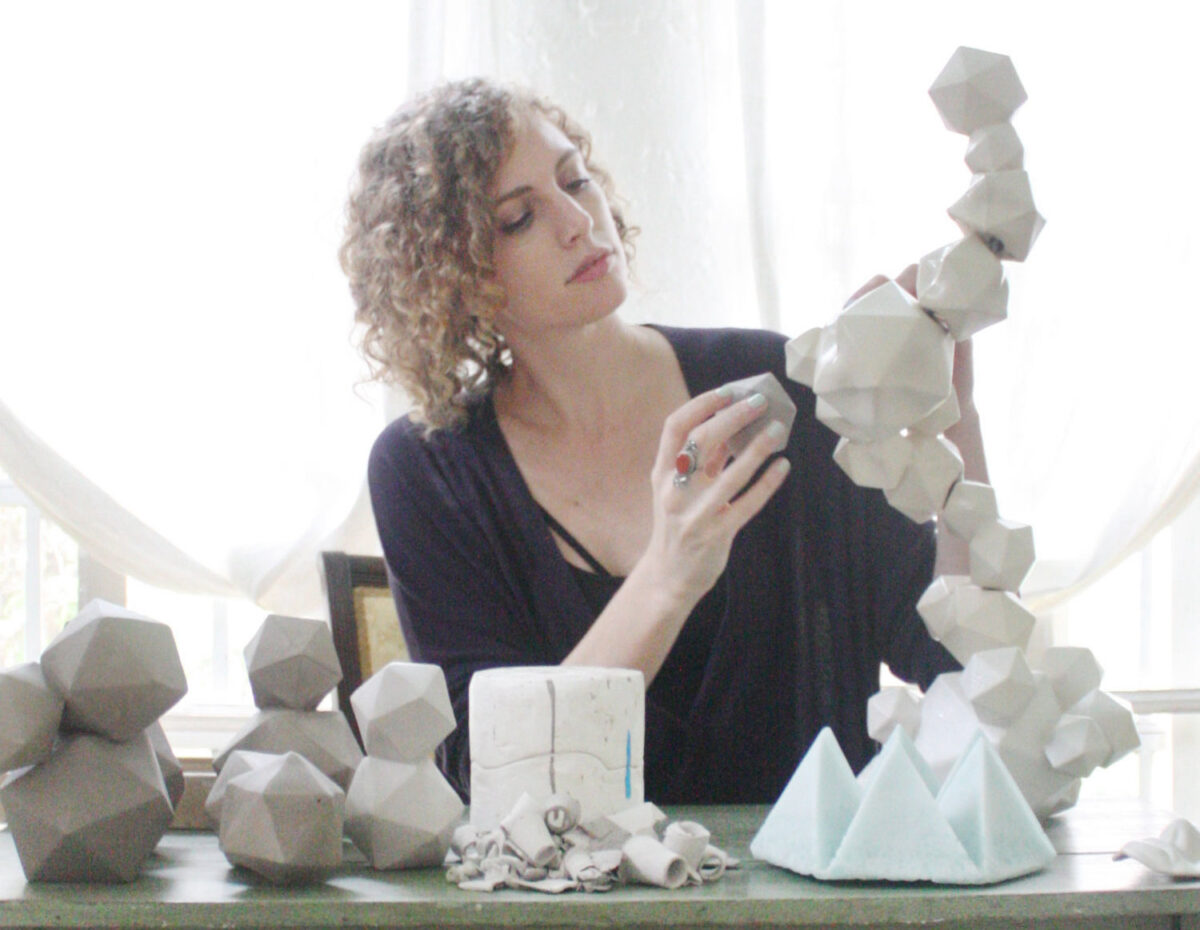
“My artwork features a significant focus on geometry, patterns, and instances of repetition, inspired largely by the hidden geometries found in nature and the notion that everything is interconnected,” Shapiro explained to JI.
“For this exhibition, my pieces include a new series of objects that incorporate 3D scans of corals loaned by scientists, crafted with these intricate geometries. When illuminated, they transform into light sculptures, adding a dynamic element to the experience,” she described.
For Shapiro, presenting her work at the Jewish Museum of Florida feels like a meaningful reconnection with her childhood community. “I grew up in a traditional family, celebrated my bat mitzvah, visited Israel, and was deeply integrated into the Jewish community during my formative years,” she reflected. “As I’ve matured, my involvement has waned, making this opportunity to engage with my roots through art particularly special. This marks my first endeavor of this kind within this community, allowing me to feel a sense of belonging once again.”
While her exhibition features sculptures like the “Crystal Coral Lamps,” which utilize her signature techniques, Shapiro’s environmental consciousness has deep roots that extend back to her childhood.
“Having been raised in South Florida, I spent an abundance of time outdoors, and nature has always been a central theme in my professional art practice,” Shapiro noted.
Her artistic journey has taken her to various ecosystems, including Brazil and French Polynesia, yet her current focus is on illuminating the ecological shifts occurring in her own backyard. “Upon graduating from grad school, I felt compelled to apply my artistic language to the broader landscape of Miami, addressing the pressing issues we face here. Our city is essentially at ground zero for sea level rise, sitting at or near sea level. It is crucial we recognize the looming environmental challenges and explore ways for people and nature to coexist harmoniously, as no one desires a lifeless landscape devoid of nature. We must critically address these issues and advocate for solutions together,” she explained.
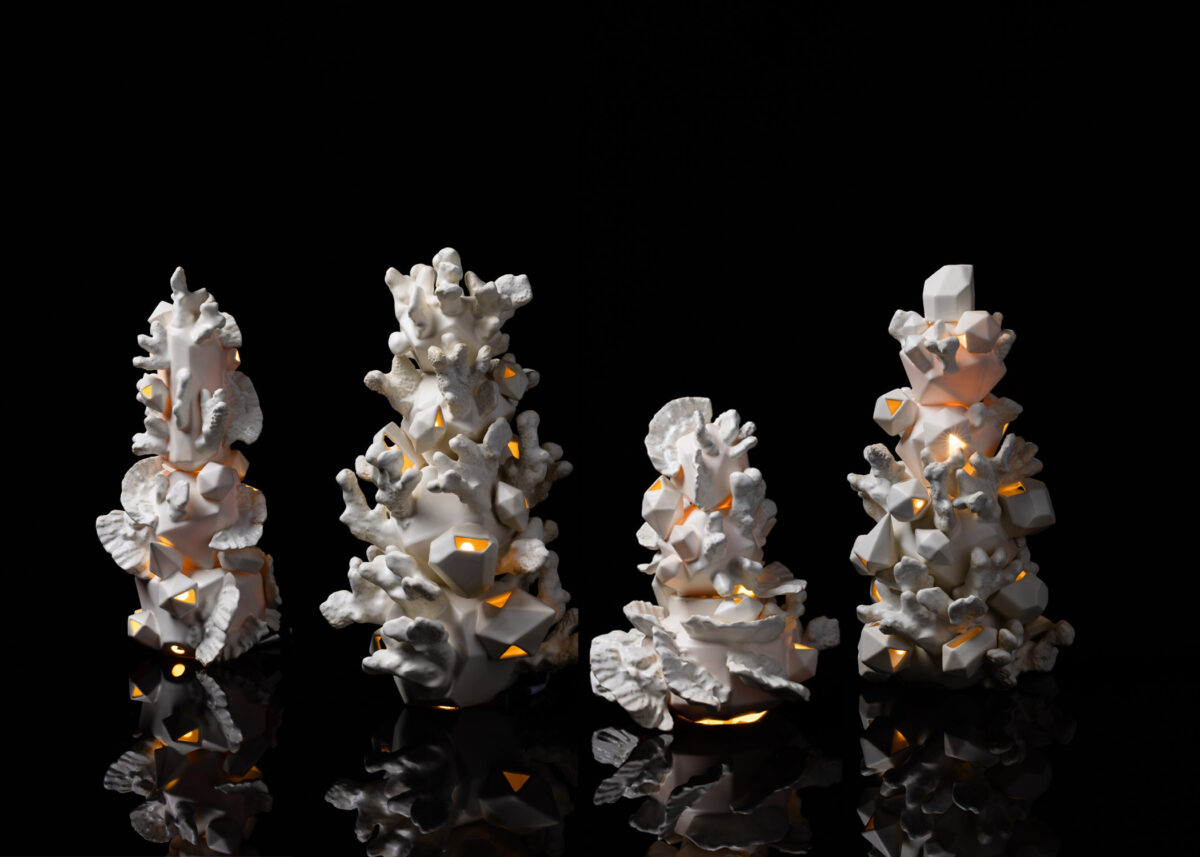
Shapiro emphasized that her installation for “Fragile Beauty” is not intended as a direct call to action, but rather aims to inspire creativity, encouraging people to engage with art and express themselves. “Many individuals feel overwhelmed by the enormity of climate change, often leading to a sense of helplessness,” she observed.
“Art possesses the unique ability to ignite inspiration and evoke emotions. People tend to care about issues they understand. When art resonates with viewers, it fosters a sense of connection and a desire to protect what they cherish,” Shapiro concluded.
*
Hailing from São Paulo, Brazil, Beatriz Chachamovits relocated to Miami four years ago. Her art has been showcased in numerous solo and group exhibitions, including the National Museum of Rio de Janeiro, and her work has been featured in Vogue and National Geographic’s educational platform. She has received an artist grant from The Village of Pinecrest and has authored and illustrated a handbook on marine life.
“Beatriz and I have been friends for many years, sharing a strong bond,” Shapiro noted of their exhibition collaboration. “She has assisted me in my installations since moving to Miami, and I have reciprocated in her projects. We share numerous connections, friendships, and thematic interests in our work, which has fostered a close relationship.”

“Collaborating with Lauren is always a rewarding experience,” Chachamovits, 36, expressed. “This is not our first exhibition together, and I cherish the opportunity to work alongside her. Our shared backgrounds as ceramicists and our mutual commitment to environmental themes make our partnership particularly enriching. Despite our individual styles, the synergy created when we collaborate amplifies our understanding of the environmental issues we address.”
Chachamovits’ artwork focuses on the alarming decline of the world’s coral reefs, specifically addressing their three primary threats: coral bleaching, ocean acidification, and plastic pollution — challenges she personally encountered during her travels.
While sketching seaweed on the island of Ilha de Boipeba in Bahia, a local approached Chachamovits, asking if she had ever drawn corals and offering to take her snorkeling. “He guided me to a breathtaking beach, where we explored a cave filled with vibrant corals and diverse marine life. This experience profoundly impacted me; I was struck by the beauty and interconnectedness of the underwater ecosystem. I left that day questioning why these wonders weren’t being discussed more widely,” she recalled.
“We spent the entire day exploring that cave, and he introduced me to larger coral formations, which cemented my commitment to raising awareness about coral conservation. This transformative experience inspired me to dedicate my life to advocating for these precious ecosystems,” she concluded.
Coming from a Jewish background, Chachamovits reflects on how her heritage fosters her connection to the ocean and corals. “A coral colony consists of numerous polyps working together, embodying the essence of Jewish culture—our unity forms a greater whole, a deeper understanding, and a more expansive community,” she expressed. “This profound interdependence resonates with me, highlighting the vital connections between our ocean environment and the principles of my Jewish identity.”
“Being Jewish is an identity that transcends individual experience. It’s an enduring part of who you are, unremovable by external factors,” Chachamovits emphasized.
Her installation for “Fragile Beauty,” titled “To Kill With Water,” is a performative piece comprising three aquariums representing different stages of acidification. The first aquarium features clay-based coral sculptures; the second contains the same sculptures submerged in water, gradually dissolving to mimic the effects of ocean acidification; the third aquarium showcases shapeless masses of clay in murky water, representing the final stage of coral degradation.
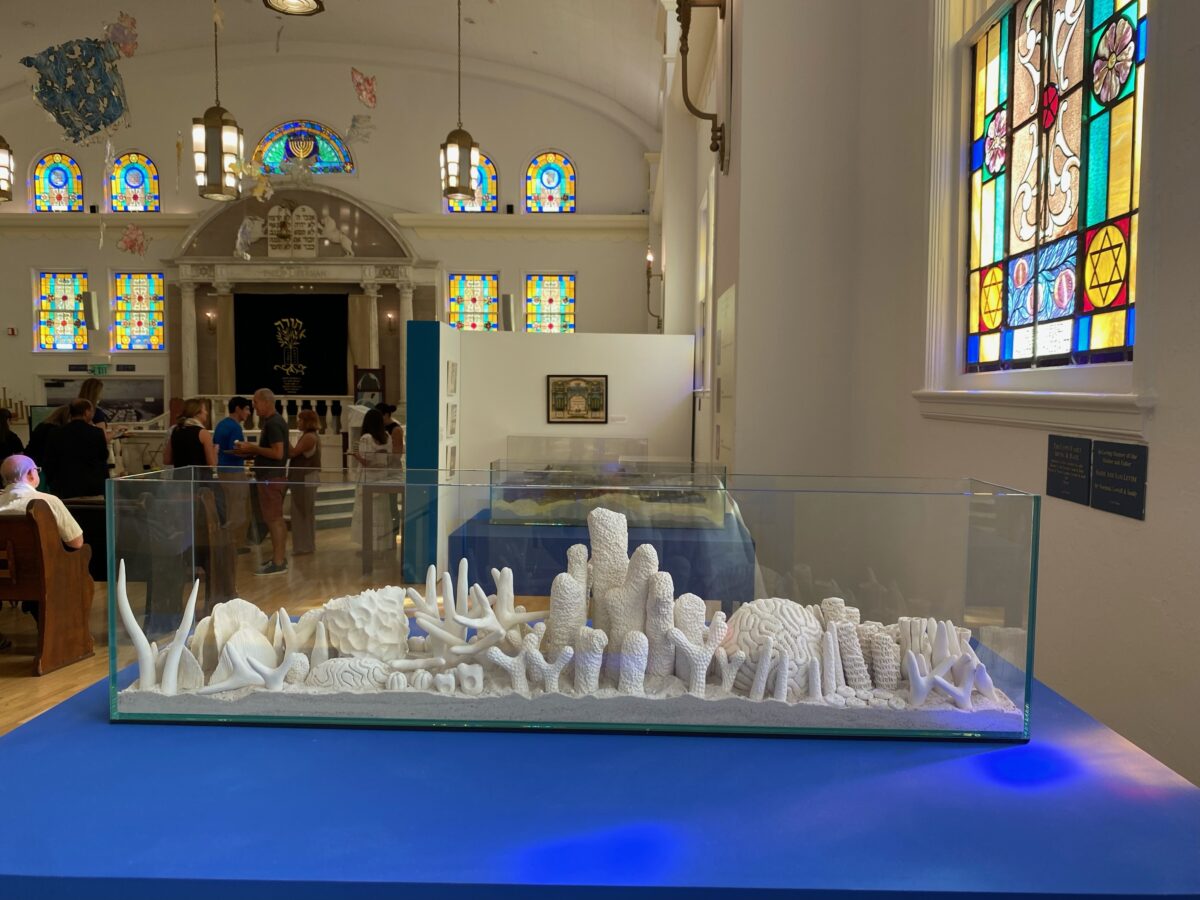
“One of my primary objectives is to cultivate a love for the ocean,” Chachamovits expressed. “I want people to realize that our daily choices and actions significantly influence the environment and the ocean’s health.”
“It is crucial for individuals to understand the deep connections we share with water and the ocean, which are vital for our existence on this planet. Without water, life cannot thrive, and corals represent the most crucial and fragile ecosystem, supporting approximately 25% of all marine life while covering less than 1% of the ocean’s surface. Recognizing their beauty, importance, and vulnerability is essential for fostering a collective commitment to their preservation,” she concluded.
