


“Beyond the lack of disassembly, mono-material packages offer significant advantages, as they fit seamlessly into existing recycling systems and require considerably less energy for production. This not only helps to minimize environmental impacts but also supports the broader goals of a circular economy,” states Rachel Marek, senior marketing project manager at PKG Group. She attributes the inception of this movement to independent brands that spotlighted the industry’s wasteful tendencies. “As more brands adopt a circular economy model, the demand for packages that are ready for recycling has surged,” she adds.
In addition to the recycling benefits, Ray Lewis, president of Nate Packaging, highlights another advantage of single-material packages: they can significantly speed up the process of testing for formula compatibility. “Knowing that the resin is compatible before testing can cut down the time needed for trials, leading to faster product launches,” Lewis explains.
Lewis also notes that there are two key areas of improvement for mono-material packaging: compatibility with current molding tools and the applications for decorating these packages.
The interplay between current molding tools and their ability to manage the dimensional characteristics of packaging—such as variations in wall thickness—can lead to issues like warping or sinking. He mentions that Nate Packaging has successfully redesigned tools to address these dimensional challenges, particularly in the production of mono-material lipsticks and compacts.
“When it comes to decorating, materials like PE and PP require surface treatments before processes like silkscreening to ensure proper adhesion,” he explains. “While ABS resin had minimal decorating challenges in the past, it is no longer considered recyclable within modern circular economy frameworks.”
Nate Packaging has been at the forefront of developing and producing mono-material packaging since 2010, utilizing single resin PP, PET, and HDPE for a variety of products including lipsticks, compacts, lip balms, mascaras, retractable eyeliner/lip pencils, deodorant sticks, SPF sun care products, and foundation sticks, among others. “Our drive towards mono-material packaging stems from a commitment to recycle as much of our common personal care plastic packaging as possible, rather than allowing it to end up in landfills across the U.S. due to mixed resin compositions that are non-recyclable,” says Lewis.
Recently, Nate Packaging has introduced molded mono-material lipstick packaging for Burt’s Bees and lip balm tubes for Hello Products, both utilizing 100% PP and 100% PET respectively.
For Burt’s Bees’ Satin and Glossy Lipsticks, a 100% mono PP resin was employed featuring 60% post-consumer recycled (PCR) PP, along with an all-PP mechanism and a 12.7mm bullet shape. In-mold logos and other decorative elements showcase the brand’s signature honeycomb pattern.
Hello Products similarly sought a mono-material solution for its Unicorn Vegan Lip Balm, collaborating with Nate to select a 100% mono PET resin that also includes 60% PCR PET, paired with a 12.5mm bullet format. The package features vibrant yellow and pink in-mold colorants, alongside two applications of spray color to create the brand’s whimsical rainbow pattern, complemented by a silkscreened logo.
<p“Burt’s Bees’ lipstick design was able to effectively showcase their iconic honeycomb pattern through our custom tooling,” Lewis elaborates. “For Hello Products, we utilized a stock tool to bring their whimsical Unicorn to life through the creative use of colorants and custom spray techniques to achieve a unique rainbow effect.”
Explore Revolutionary Mono-Material Packaging Solutions
The landscape of mono-material packaging is continuously evolving as manufacturers respond to the beauty and personal care industry’s demand for sustainable packaging solutions that do not compromise on functionality or aesthetics.
Mono-material packaging stands out as one of the fastest growing product categories at International Cosmetic Suppliers Ltd. (ICS). The company provides a comprehensive selection of mono-material essentials, including jars, bottles, tubes, pan sticks, pencils, compacts, palettes, and rollerballs, all crafted from PP, PET, or PE.
According to Tara Stein, vice president of sales and business development at ICS, mono-material packaging offers a range of benefits beyond its recyclability. “For instance, the design of our one-piece, mono-material, PE flip-top tubes not only reduces injection cycle time but also streamlines the assembly process, which leads to lower energy consumption,” she explains. “Additionally, they utilize less plastic than traditional tubes, making them a more cost-effective choice.”
ICS’s mono-material packaging options are meticulously crafted to satisfy both aesthetic and sustainability goals while ensuring that they meet functional and performance criteria. By utilizing the same resin across all injected components, these packages achieve consistent color uniformity.
While recyclability has posed challenges for dual-ended pencils that traditionally incorporate multiple materials, Stein points out that ICS’s Mono-Material PP Slim Retractable Brow Pencil with Removable Applicator simplifies the recycling process. “Users can easily detach the applicator and place the remaining parts into the recycling bin,” she enthusiastically states. “[This design prioritizes functionality and sustainability; the barrel, inner mechanisms, and caps are all made from 100% PP and are available in an array of applicator styles, including brush, comb, and sponge options.”
At WWP Beauty, the advancement of mono-material packaging is being approached through two main strategies: adapting current designs to incorporate mono-material structures and creating new designs that are specifically focused on mono-material components.
Gary Myer, vice president of engineering at WWP Beauty, emphasizes the importance of tooling design and engineering in exploring material and packaging capabilities. “For example, crystalline materials like those found in lipsticks and compacts are ideally suited for manufacturing with PET, including new chemically recycled PETG and other innovative renewable materials under development, as these materials share similar properties with ABS, SAN, and PETG typically used,” he explains. “These package types are particularly advantageous as they do not necessitate leak-proof seals, which are often essential for liquid and semi-liquid formulations.”
Secondary development focuses on new designs and tooling that leverage an understanding of the physical and chemical properties of available materials. “This includes options like iPET, rPET, PCR PP, and PCR HDPE, along with emerging renewable materials,” he adds. “We have achieved significant progress in this area, exemplified by our all-PE plastic tubes featuring a sleeve, tube head, and disc-top or flip-top, all made from the same material—whether virgin PE, PCR PE, or bio-sourced PE.”
Among WWP Beauty’s latest mono-material introductions are lip balm packaging made from Biobase Nature2Need, mono-material compacts featuring bases, covers, and platforms crafted from Biobase, IPET, and Molecular Recycled Resins, as well as mono-material tubes made from PCR Ocean Plastic, PP, and PCR Biobase materials.
Additionally, the company offers lipstick packages made entirely from PET and PP. Its Mono-Material Refillable Lipstick is marketed as a luxurious, ready-to-recycle mono-material option that features an intuitive design for easy refilling. Myer notes that it reduces carbon dioxide emissions by 24% after the first refill and by 70% after the fourth refill compared to traditional lipsticks that incorporate metal components.
Moreover, WWP Beauty’s innovative Mono-Material ColorVue Lipstick is a 100% mono-material PP configuration that employs a patented R2 Sleeve Mechanism, using 12% less plastic and generating 85% fewer harmful emissions per piece compared to standard lipstick packaging.
Next-Generation Mono Dispensing Solutions
When considering mono-material packaging, one might initially think of basic bottles and jars with standard snap-on caps or threaded closures. However, the world of dispensing options is rapidly advancing to meet modern demands.
One notable innovation is SeaCliff Beauty’s 100% PE Mono Material Airless Systems, a metal-free solution that ensures 100% recyclability without any need for disassembly. “Our Mono-Material Airless Systems can be utilized in various packaging styles, perfect for micro-encapsulated formulations and SPF products,” explains Amanda Deak, the senior marketing manager for the company. “Depending on the formulation, we provide different output styles to ensure precise dosage for every application.”
This configuration accommodates five distinct formula viscosities, including liquids, oils, foundations, lotions, and creams. Notably, the system is available in Green PE (Braskem Sugarcane PE) and SeaCliff’s Sage Airless System technology is recognized as the lightest airless system currently available on the market.
Deak mentions that fully recyclable pump delivery systems are still rare, but SeaCliff’s 100% PE tube pumps offer a high-quality airless option that facilitates easy recycling. “Our tubes are crafted using a multi-layer process that can include up to six layers, providing customers with choices such as barrier layers or highly decorative finishes,” she adds.
Andrea Greff, design manager at NF Beauty Group, highlights a key benefit of mono-material packs: consistent design and coloring. “Often, when different plastics are used for packaging—such as a PP cap paired with a PET or ABS bottle—clients strive to achieve a uniform color injection. However, when samples are reviewed, the different plastics yield color results in distinct ways,” she explains. “With mono-materials, consistency is achieved since both the cap and bottle are made from the same material, ensuring a perfect match for the brand.”
One of NF Beauty Group’s standout mono-material designs is the Calista Bottle, an airless option featuring a sleek, capless design along with PP components. This bottle is also available in a refillable version, catering to eco-conscious consumers.
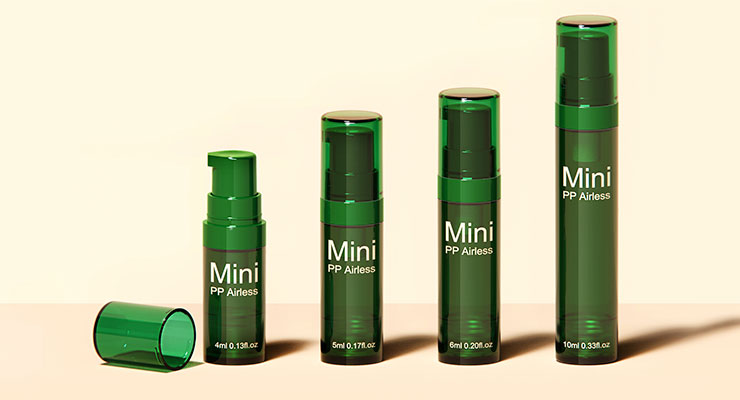
PKG Group adheres to a principle of sustainable innovation, offering a diverse array of packaging solutions in PE, PP, PET, and LDPE that complement its patent-pending single-material bellows pump assembly. This pump, constructed entirely from PP, is available in six different dosage sizes (150mcl, 200mcl, 500mcl, 1cc, 2cc, and 3cc) thanks to a collaboration with Yonwoo. Marek notes that the pump replaces the conventional metal spring found in pumps with a PE bellows spring and swaps POM with recyclable PP, allowing the entire pump to be recycled as a single unit.
“The bellows pump engine integrates seamlessly into existing stock packages, eliminating the need for custom tooling,” explains Andrew McCurdy, sales representative at PKG Group. “This flexibility provides our clients with a broad spectrum of options ranging from budget-friendly packages to high-end luxury components.”
McCurdy further reveals that the PP bellows pump engine is also suitable for airless pump tubes with PP sleeves, resulting in nearly 99% of the package being composed of PP, with a minimal amount of PE.
For brands seeking a sustainable and reliable mono-material dropper solution, APC Packaging has unveiled a patented mono-material dropper and bottle set featuring an all-PP bulb, dropper collar, pipette, wiper, and bottle.
According to Robert Bulla, director of engineering and innovation at APC Packaging, this dropper is the first of its kind on the market, combining patented technology with a crystal-clear pipette that stands out in contrast to the typically hazy alternatives.
“APC Packaging has developed a mono-material system aimed at designing comprehensive mono-material packages,” he elaborates. “The outcome has been remarkable, as we are not only achieving mono-material packaging but also delivering visually appealing and desirable solutions that resonate with brand identities.”
Pennelli Faro Launches Eco-Friendly Brushes Crafted from 100% Recycled Water Bottles
While the convenience of water in plastic bottles is undeniable, the environmental repercussions of their production and disposal are significant, contributing to pollution and landfill overflow. In response to these challenges, Pennelli Faro has introduced Solo, the first mono-material brush on the market made from 100% post-consumer water bottle waste, produced using 100% green energy and sustainable methods.
The Solo collection is not only recycled but also recyclable, encompassing everything from synthetic fibers to handles. Pennelli Faro’s Sara Zanafredi, CEO, emphasizes that the company employs cutting-edge technology and innovative processes throughout the production and assembly of these brushes to eliminate the need for adhesives or metals. Additionally, no toxic inks are used for decoration.
The Solo brushes embody the sustainable ethos that Pennelli Faro has integrated into its operations since it established its production facility 12 years ago, incorporating a circular model into every facet of the business—from headquarters and manufacturing processes to product development and creation.
One of the initial clients to embrace the Solo line is a brand focused on organic cosmetics. Zanafredi shares that this client opted for a compact range of five Solo makeup applicators in a custom color palette, aligning perfectly with their philosophy of providing “vegan products created with simplicity.”