


One of the most common inquiries we receive at Pairfum London revolves around understanding scent categories. Customers often ask: “What are Olfactive Families?” and “How do you articulate your favorite fragrance?” These questions highlight an essential aspect of the fragrance world.
- “What are Olfactive Families?” and
- “How do you describe your Favourite Perfume?“
With the tremendous selection of fragrances available today, it’s easy to feel inundated by the myriad of scent profiles. Each fragrance offers a unique sensory experience, and distinguishing between them can be challenging. Utilizing Olfactive families provides a structured approach to navigate this vast world and helps pinpoint your potential new favorite scent while also deepening your understanding of beloved classics.
While it may seem daunting, I understand your hesitation. Many people find it challenging to articulate their preferences amidst such variety.
Exploring the Evolution of Olfactive Families
Before we delve into the specifics of olfactive families, it’s crucial to consider who established these classifications and when they were introduced. The evolution of fragrance classification reflects both historical context and advancements in scent formulation.
- Who or what defines and gives us these classifications?
- When did it begin, and how do these classifications vary?
It’s important to clarify that olfactive families pertain to the final scent of the perfume, not merely the ingredients used. Essentially, these classifications describe and categorize the olfactory experience rather than the composition itself. The first fragrance classifications emerged around the early 1900s, consisting of seven families. As synthesis techniques advanced in the late 19th century, there arose a necessity to refine and expand these categorization methods.
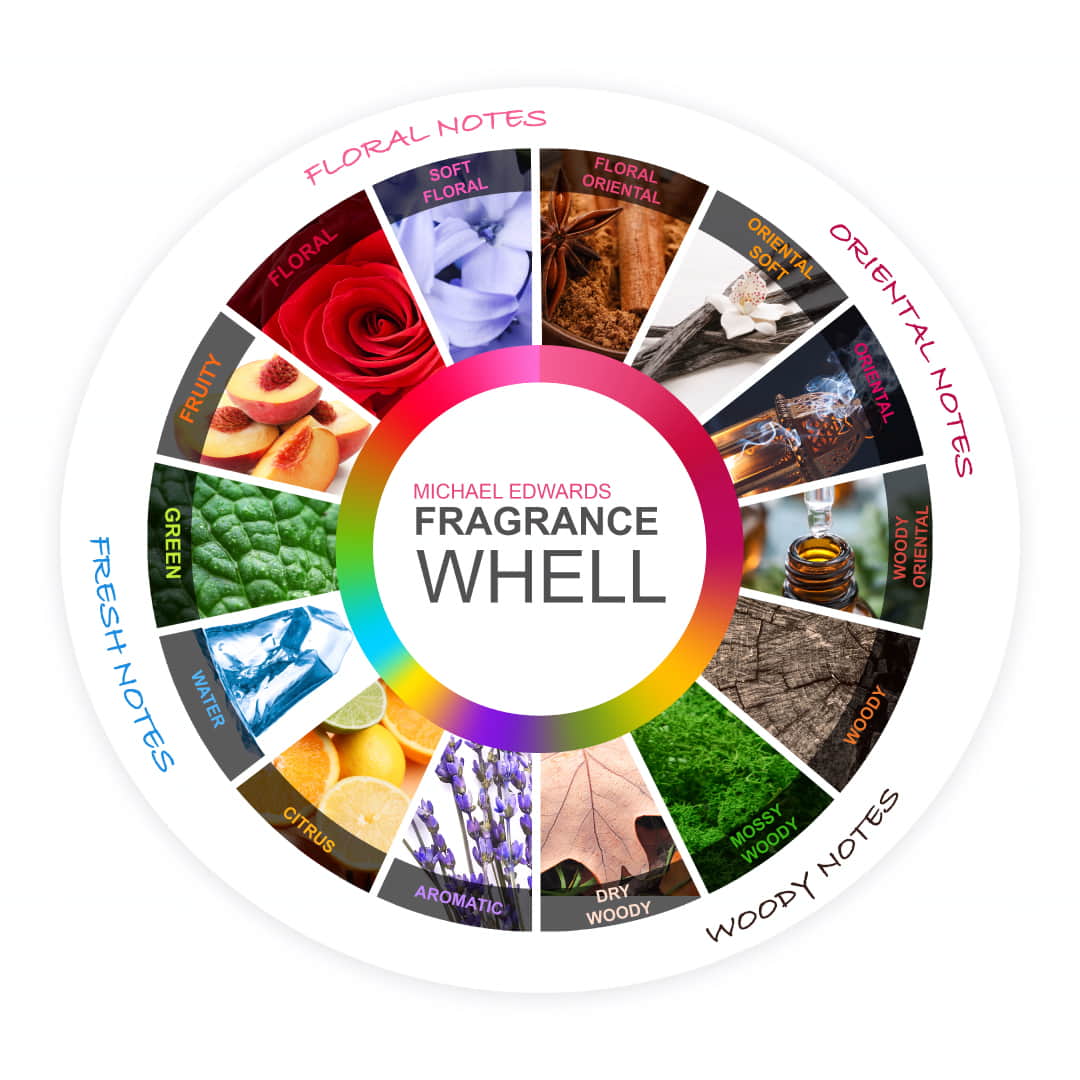
In 1949, the Austrian perfumer Paul Jellinek introduced the inaugural fragrance wheel, called the ‘Odor Effects Diagram.’ This circular diagram illustrates the inferred relationships between olfactory families based on similarities or differences in scent. On this wheel, adjacent perfume groups are suggested to share common olfactory traits, enhancing your ability to navigate through various fragrance profiles.
Since Jellinek’s original wheel, numerous iterations have been developed. Notable versions include the 1983 adaptation by perfumer Michael Edwards and the ‘Fragrance Circle’ conceived in 1979 by U. Harder at Haarman & Reimer, which later became part of Symrise. Edwards’ version has undergone multiple revisions, the latest being in 2010. This current iteration categorizes scents into four primary families—Floral, Oriental, Woody, and Fresh—each further divided into three sub-groups to encompass a broader array of fragrance types.
Understanding Diverse Perfume Classification Systems
Within the enchanting realm of perfumery, there exist several prominent Perfume Houses, four of which include:
- Firmenich,
- Givaudan,
- International Flavors & Fragrances (IFF), and
- Symrise.
It’s essential to clarify that when we mention ‘Perfume Houses,’ we are not referring to popular brands like Chanel, Dior, Estee Lauder, Versace, or Gucci, which primarily market their own perfumes. Instead, we refer to the classical houses, such as Firmenich and Symrise, renowned for nurturing and training some of the world’s top perfumers.
Each of these prestigious houses has its own unique system for classifying scents, which often varies from one another. For instance, Firmenich classifies fragrances into categories such as Chypre, Citrus, Floral, Oriental, Aromatic, and Woody. Other companies like Symrise, IFF, or Givaudan utilize different classification systems, which can lead to diverse interpretations of similar fragrance notes.
A Comprehensive Overview of Major Olfactive Families
The olfactive families serve as crucial categories in the fragrance world, encompassing major families such as Citrus, Chypre, Floral, Floriental, Aromatic, Oriental, and Woody. Each of these families can be further subdivided into various subfamilies, which helps to refine the classification and understanding of different scents.
Discovering the Bright and Fresh Citrus Family
The term “citrus” refers to the essential oils derived from the zests of fruits like bergamot, lemon, orange, and mandarin, often complemented by orange blossom products. This family is particularly popular among both men and women, prominently featured in classic “Eau de Cologne” fragrances. Within this family, you will also find variations such as Spicy Citrus, Aromatic Citrus, Floral Chypre Citrus, Woody Citrus, Floral Woody Citrus, and Musky Citrus, each adding a unique twist to the citrus profile.
Exploring the Alluring Floral Family
The Floral family is characterized by fragrances that center around a single flower as the main ingredient, including blossoms like jasmine, rose, violet, tuberose, lily of the valley, and narcissus, among others. This family showcases various interpretations of floral notes, including Soliflore (single-flower), Floral Musky, Floral Bouquet, Floral Aldehydic, Floral Green, Floral Fruity Woody, Floral Woody, and Floral Marine compositions, catering to a wide range of olfactory preferences.
Unveiling the Richness of the Fougere Family
The term “Fougere,” often associated with the scent of ferns, does not suggest a direct representation of fern fragrances. Instead, this family is characterized by a harmonious blend of notes including lavender, woody elements, oak moss, coumarin, and bergamot. Within this olfactory family, you will find variations such as Floral Amber Fougere, Soft Amber Fougere, Spicy Fougere, Aromatic Fougere, and Fruity Fougere, each offering its unique interpretation of the fougere scent profile.
Exploring the Timeless Chypre Family
The origins of the Chypre fragrance family are believed to date back to Roman times, with the term ‘chypre’ first noted in the 18th century. However, it gained widespread popularity with the launch of ‘Chypre de Coty’ in 1917 by the trailblazing perfumer François Coty. The Chypre family encompasses various accords, including Fruity Chypre, Floral Aldehydic Chypre, Leather Chypre, Aromatic Chypre, Green Chypre, and Floral Chypre, each presenting a distinct blend of scents.
Understanding the Warm and Earthy Woody Family
The Woody family comes to life when warm, opulent notes like sandalwood or patchouli are combined with dry notes such as cedar or vetiver, along with top notes of lavender and citrus. This family includes subcategories like Woody, Woody Citrus Coniferous, Woody Spicy, Woody Amber, Woody Aromatic, Woody Spicy Leather, Woody Marine, Woody Fruity, and Woody Musky, showcasing a vast array of olfactory experiences.
Delving into the Alluring Amber-Oriental Family
The Amber or Oriental family features fragrances characterized by their soft, powdery notes, including vanilla, cistus, labdanum, and prominent animalistic scents. This family comprises six sub-groups: Soft Amber, Floral Spicy Amber, Citrus Amber, Floral Woody Amber, Floriental, and Floral Fruity Amber, each offering a unique scent experience.
Unraveling the Distinctive Leather Family
The Leather family presents a unique concept within perfumery, characterized by dry, sometimes very dry notes that aim to replicate the distinctive aroma of leather. This family includes notes of smoke, burnt wood, silver birch, and tobacco, often combined with floral nuances. The subfamilies feature variations such as Floral Leather and Tobacco Leather, with harmonies of wood, honey, and hay that define the Virginia tobacco note.
Exploring the Sweet and Juicy Fruity Family
The Fruity family is known for its limitless potential, offering delightful fragrances that feature a variety of fruits such as berries (strawberries, raspberries, blueberries), juicy fruits (peaches, nectarines, mangoes), exotic tropical fruits (coconut, pineapple), kiwi, and melons. Unlike the aforementioned categories, the Fruity family is most commonly found in skin care and toiletries products, such as shower gels, soaps, and lotions, which frequently introduce new fruit varieties compared to traditional Eau de Toilette offerings.

Understanding Olfactive Families: A Guide to Fragrance Classification
Olfactive families serve as a sophisticated means of categorizing perfumes based on the actual notes they embody, rather than simply the ingredients that comprise them. Essentially, these families provide a framework for analyzing and interpreting how a fragrance smells, as opposed to merely detailing its constituent parts.
While many fragrances may be described using approximately 10-20 dominant notes, the world of perfumery is incredibly diverse, containing literally thousands of unique scents. Utilizing olfactive families is an effective method for grouping perfumes according to their profiles, enabling enthusiasts and novices alike to

Sienna Blake is a licensed aesthetic consultant and beauty writer specializing in cosmetic surgery advancements and non-invasive treatments. With a background in dermatology and over eight years of industry experience, Sienna is passionate about helping people achieve confidence through informed beauty decisions. She holds a Bachelor's degree in Health Sciences and regularly collaborates with top plastic surgeons to stay at the forefront of aesthetic innovations. Outside of her work, Sienna enjoys traveling, skincare research, and practicing Pilates.
