


At Eminence Organic Skin Care, our hearts overflow with gratitude for the incredible gifts that nature provides. From vibrant fruits and nutrient-rich seeds to healing herbs and beautiful flowers, countless plants play a vital role in enhancing our health, enriching our diets, and, of course, transforming our skin care routines. Each product we offer is infused with potent botanicals, allowing us to witness the remarkable power of organic ingredients firsthand. With this understanding, we feel a profound responsibility to give back to the planet that sustains us. This commitment led to the creation of our Forests for the Future™ initiative in 2013.
Through this impactful initiative, we plant a tree for every product sold, fostering a sustainable cycle of giving back to the earth. Additionally, we provide training for local farmers and support environmental restoration projects in the rural communities where these trees are planted. This initiative is made possible through our partnership with Trees for the Future, a remarkable non-profit organization dedicated to improving the livelihoods of impoverished farmers. They achieve this by training them in agroforestry and sustainable land use practices, while also coordinating the hands-on efforts required to turn our shared vision into a tangible reality.
Let’s take a moment to meet David Abach, a dedicated farmer from Kenya who has shared his inspiring story about the numerous benefits his farm has experienced since joining this transformative program. Together, we can explore the profound impact that both Eminence Organics and Trees for the Future are making in the lives of farmers like David.
Discover the Transformative Journey of David Abach
When David embarked on his journey with the Eminence-sponsored Trees for the Future’s Forest Garden Training Program in 2020, he identified that approximately half a hectare of his farmland could be transformed into a thriving Forest Garden. This program represents a significant shift towards sustainable agriculture, allowing farmers to utilize their land more effectively while contributing positively to the environment.
Over the past decade, Trees for the Future has pioneered the Forest Garden approach, which employs regenerative farming principles to replicate a natural forest ecosystem within existing agricultural lands. These Forest Gardens consist of a diverse array of trees, shrubs, fruits, vegetables, and herbs, strategically placed to provide each plant with the necessary support for growth. This not only fosters biodiversity but also replenishes the soil with essential vitamins and minerals, ensuring the land remains fertile and productive for years to come.
Through the education and resources provided by the program, David quickly began to grasp sustainable and regenerative agroforestry techniques that would directly benefit his land. This knowledge empowers farmers to create more resilient and productive ecosystems on their farms, ultimately leading to improved food security and increased income.
Enhancing Agricultural Practices for a Healthier Farm
Farms that adopt the Forest Garden model yield a wide variety of nutritious, wholesome crops, providing farmers with access to healthy food while boosting their income and enhancing biodiversity. David proudly shares, “[My farm] is better today. Previously, I planted only maize and beans. But because of Trees for the Future, I have Cajanus trees and a variety of vegetables for my family’s nutrition.” This shift not only benefits David’s immediate family but also contributes to the overall health of the community.
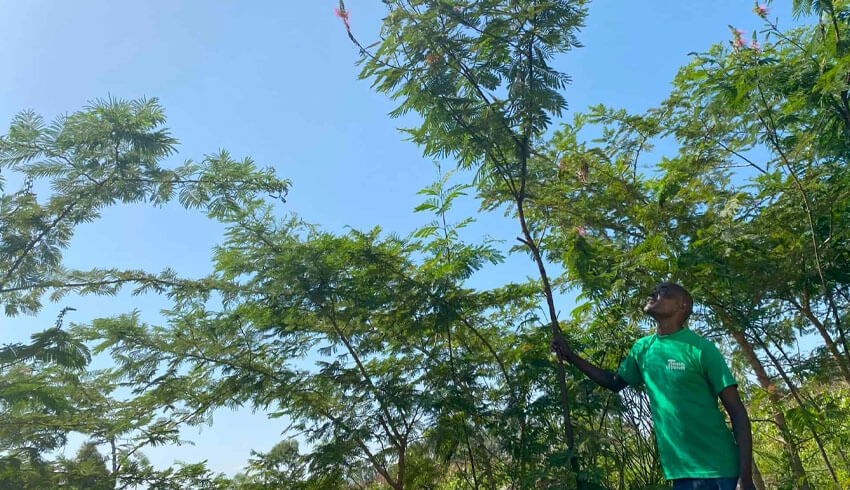
David is employing various regenerative agroforestry techniques within his Forest Garden, including a method known as alley cropping. This technique utilizes rows of trees or shrubs to establish alleys, which create the optimal conditions for cultivating multiple crops in a limited space. By incorporating Cajanus (pigeon peas) into his alley cropping system, David enhances the nutrient content of his soil, fostering a thriving ecosystem. These trees form a living fence around the perimeter of his Forest Garden, enriching the soil, providing animal fodder, and acting as a windbreak. “Without the trees … very heavy wind can fell the crops,” David explains, highlighting the importance of this natural barrier in protecting his livelihood.
Growing a Forest: Thousands of Trees, Lasting Impact
In just three short years, David has transformed his land from having a mere 12 trees to boasting over 3,300 flourishing trees. While these trees are still in their growth phase, they are already creating a vital microclimate that benefits his farm immensely. This transformation is essential for combating the challenges presented by Kenya’s variable climate.
As David notes, “During the dry season, there is [a different] climate within the [Forest] Garden.” The presence of trees serves a critical function, helping crops retain moisture and reducing the vulnerability of his plants during periods of drought. This innovative approach to farming is not only about survival; it’s about thriving even in challenging conditions.
Unlocking Opportunities in the Carbon Market
As a participant in the Trees for the Future program, David has gained access to the burgeoning carbon market, which represents a critical opportunity for sustainable agriculture. The carbon market enables organizations to buy and sell “carbon credits,” providing essential funding for environmental projects and allowing corporations to offset their greenhouse gas emissions.
The trees flourishing on David’s farm will enable him to earn an additional stream of income through the sale of carbon credits. This is a significant advantage for Trees for the Future Forest Garden farmers in Kenya, as it opens up new financial avenues while promoting environmental sustainability. By participating in this market, David is contributing to the broader fight against climate change while enhancing his own financial stability.
Improving Soil Quality for Sustainable Agriculture
Outside the confines of his Forest Garden, David continues to cultivate maize and beans using traditional farming methods. However, the stark contrast in soil quality between the crops grown inside and outside the Forest Garden is striking.
“There is a big difference in soil quality,” he remarks. “If you compare where there are vegetables growing alongside the Cajanus and where there is maize [without Cajanus], you find that the maize is yellow. It shows that there is nutrient deficiency—unlike where I am using compost. I see that the Forest Garden is better.” The Cajanus trees play a crucial role in enriching David’s land with nitrogen, leading to the production of robust and healthy crops that can be sold at market or used to nourish his family.
Building a Sustainable Future for His Family
From enhancing food production to actively participating in climate change mitigation, David is leveraging his Forest Garden, shaped by these impactful initiatives, to create a better life for himself and his family of 13. This journey has transformed his approach to farming and has provided him with newfound hope.
“Before, I had to take money from my pocket to get vegetables. Now, because I get vegetables from my Forest Garden, what I would have used to buy vegetables I can use to buy fish and meat and school items for my children.” This statement reflects the profound changes in David’s life since he joined the Trees for the Future Forest Garden Training Program, partly funded by Eminence Organic Skin Care. He now has access to the education and resources needed to secure a stable source of food and income, paving the way for a brighter future.
Read more about David’s inspiring journey and the positive impact of our initiatives here.