

Meriam-Webster’s Word of the Year for 2022 is “gaslighting,” reflecting its significant rise in usage. The latest fragrance captures the essence of aged books, while we ponder what Siri might have been like if it had existed in the 1970s. Dive into the eerie realm of Victorian Christmas cards and explore E Ink-based playing cards that are on a quest for a game. A creative father skillfully alters photos to mirror his child’s imaginative drawings. In a groundbreaking study, graphene is set to be tested on the moon. Innovations like “Apple Health, but for dogs” are on the rise. Did you know that in the 16th century, animals were subject to lawsuits? The James Webb Space Telescope now observes galaxies in collision. And, prepare yourself for the theatrical release of “Bambi: the Reckoning.” Plus, Olive Garden is launching matching family pajamas. Discover all this and more in WhatTheyThink’s weekly roundup of intriguing tidbits.
Unraveling the Concept of Gaslighting in Modern Culture
For aficionados of classic cinema, the term “gaslighting” may evoke memories of the 1944 film Gaslight, starring Charles Boyer and Ingrid Bergman. In this gripping psychological thriller, Boyer manipulates his wife into believing she is losing her mind, primarily by orchestrating mysterious flickers of the house’s gas lights. This term, which has become synonymous with psychological manipulation, highlights how deceptive tactics can profoundly impact a victim’s sense of reality. If this movie were made today, would it be called “LEDlighting”? It’s fascinating to consider how modern technologies could amplify such manipulative behaviors, possibly extending their reach far beyond the original context.
The term “gaslighting” transitioned into everyday language shortly after the film’s release, gaining traction over the decades. However, its usage surged dramatically in 2022, earning the title “word of the year” from Merriam-Webster. According to a report by Smithsonian, the spike in interest was remarkable:
Merriam-Webster reported an astonishing 1,740 percent increase in online dictionary searches for “gaslighting” in 2022, maintaining its position among the top 50 most-searched words throughout the year, as noted by Peter Sokolowski, the company’s editor at large.
In what contexts is “gaslighting” appearing in the news?
Individuals grappling with long Covid have adopted the phrase “medical gaslighting” to express their frustrations with the healthcare system’s tendency to dismiss their genuine symptoms. Additionally, Congresswoman Carolyn B. Maloney accused Big Oil of “gaslighting” the public regarding environmental issues. This term has become a versatile descriptor for manipulative behavior in various relationships, ranging from personal partnerships to political arenas.
Merriam-Webster provides two concise definitions of “gaslighting”:
It refers to a form of psychological manipulation that occurs over an extended period, resulting in the victim questioning their own thoughts and perceptions of reality. This often leads to confusion, diminished self-esteem, uncertainty regarding one’s mental stability, and a growing reliance on the manipulator.
Additionally:
It signifies the act of grossly misleading someone, particularly for personal gain.
For a playful twist, try this: When someone tells you that “gaslighting” is the word of the year, adamantly maintain that it isn’t!
Exploring Unconventional Fragrances: The Scent of Old Books
In previous discussions on unique fragrances, we’ve explored various scents that transport wearers to the nostalgic aroma of old books. Our Mount Monadnock Media Maven highlights a newly launched fragrance that stands out in this category, created by a perfumer who admits to disliking conventional perfumes. Enter CB I Hate Perfume’s latest offering, In the Library:
This fragrance is a warm fusion of scents reminiscent of English novels, Russian and Moroccan leather bindings, worn textiles, and a subtle hint of wood polish.
*The primary note in this delightful concoction was inspired by one of my cherished novels published in 1927. I stumbled upon a signed first edition in impeccable condition years ago in London, and I was overjoyed since only a hundred copies were ever made. It exuded a wonderfully warm, woody, and slightly sweet aroma, prompting me to bottle it for others to enjoy.
Every time I delve into a book, the experience begins with the joy of opening it and inhaling deeply. Few things compare to the delightful scent of a well-loved book. Newly printed books emit quite a different fragrance than their older counterparts; their ink is crisp while the paper emits a barely-there scent. In contrast, older books carry a richer and often sweeter aroma. Illustrated volumes present a distinct odor compared to straightforward text, often hinting at their quality.
It’s intriguing to wonder if the folks at Inkjet Insight have ever inquired whether any production inkjet vendors plan to modify the scent of their inks to cater to aficionados of book aromas. (We think we might already know the answer.)
Imagining Retro Smart Assistants: Siri in the 1970s
Gizmodo poses an intriguing question: “What if smart assistants had been invented before Star Wars, smartphones, or even personal computers?” What if Siri had been available in the 1970s? (Actually, the best thing about the ’70s is probably that it didn’t have Siri at all.) Nonetheless:
Despite their current limitations, Maker Cameron Coward’s latest video transports us back to the ’70s, showcasing what smart assistants might have looked like in an era before voice recognition and personal computers. During that time, an electric typewriter would have been the primary means of interaction.
Using a Texas Instruments Silent 700 Terminal as his basis, Coward transformed this device into a “smart” typewriter that could interact with commands via a telephone modem instead of voice activation. This marks the second iteration of his concept.
In this updated version, detailed on Instructables, Coward utilized a more affordable and streamlined ESP32 that connects to Wolfram Alpha via Wi-Fi, while communicating with the Silent 700 typewriter through its serial port—consider this the distant ancestor of today’s USB ports. The revamped smart typewriter boots up in mere seconds, responding to inquiries without requiring specific phrasing or commands, much like contemporary smart assistants do.
We find ourselves appreciating Siri a lot more after witnessing this innovative retro technology.
Do we really? Are we truly?
Victorian Christmas Cards: A Look into the Past
Today’s Christmas cards often feature personalized collages from services like Shutterfly, showcasing family photos, a stark contrast to the mass-produced cards of yesteryear. Typically adorned with festive imagery—snowflakes, Christmas trees, and ornaments—these modern cards are far removed from their 19th-century counterparts. A fascinating dive into Mental Floss reveals the strange and sometimes unsettling world of Victorian-era Christmas cards.
Before the introduction of the Penny Post in 1840, mailing Christmas cards was prohibitively expensive. This new postal rule allowed items weighing under half an ounce to be mailed for just a penny. Consequently, the first commercial Christmas card, designed by John Calcott Horsley and sent by Henry Cole in 1843, depicted a cheerful family gathered around a table, conveying the message “A Merry Christmas and a Happy New Year to you.” While simple by today’s standards, it was revolutionary at the time, igniting a Christmas card mailing frenzy. However, as the novelty wore off, people sought out more unusual imagery.
Victorian Christmas cards featured bizarre and sometimes macabre illustrations, such as a frog’s gruesome aftermath, a plate of dead birds, and unsettling visuals of humans emerging from the bellies of eerie snowmen. Strange depictions of animals, fruits, and vegetables also made appearances, like menacing walking potatoes and Christmas dinner ingredients waltzing to the tune of a violin-playing rabbit.
The unsettling nature of some imagery reflects the differing values between the Victorian era and today. While we might find the portrayal of dead robins disturbing, it was interpreted as a good luck charm during that time: a ritual often performed on St. Stephen’s Day (the day after Christmas), where small birds were killed to celebrate. Sending images of these deceased creatures was meant to bring good fortune.
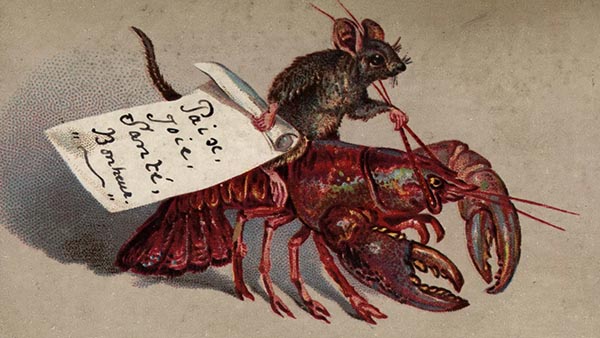
These historical insights could inspire some fascinating new templates for Shutterfly!
Revolutionizing Gameplay with E Ink Playing Cards
Speaking of cards, regular readers of Around the Web are familiar with our enthusiasm for E Ink technology, which initially gained fame through the original Kindle e-readers. This remarkable technology has made its way into various devices, and we recently discovered an exciting prototype: E Ink-based playing cards.
Wyldcards are innovative playing cards equipped with E Ink displays (similar to those in Kindle devices). When placed on a designated plinth, the images on the cards can be altered by a concealed computer system. Additionally, each card contains a memory chip that stores statistics, moves, and status effects, allowing for seamless transitions between games. You can easily connect your plinth to a friend’s for multiplayer gaming.
While “plug your plinth into a friend’s” may not become a catchy marketing slogan, there’s no denying that these cards are visually impressive.
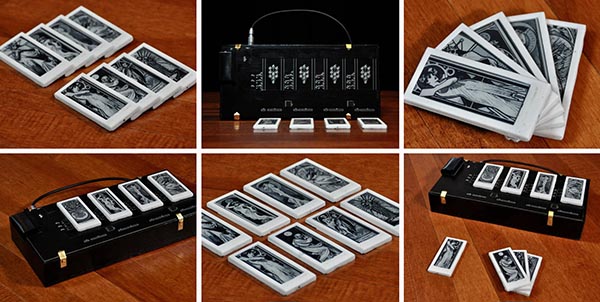
These cards have the potential to unlock an entirely new realm of tabletop gaming. They maintain a physical connection while enabling the implementation of complex game mechanics powered by computer technology.
I haven’t developed a game for them yet, but I have numerous concepts in mind and am eager to explore the new interactions and mechanics they facilitate. If anyone is interested in collaborating on game design or sharing ideas, feel free to reach out via email: [email protected]
Transforming Children’s Art into Reality
Children are known for their imaginative drawings, often cluttering family refrigerators with their colorful creations—especially when it comes to animals. However, by the time they reach adulthood, these charming depictions might not accurately represent their subjects, particularly when it comes to creatures like horses. Nevertheless, one devoted father has taken it upon himself to bridge the gap between a child’s drawing and its real-life counterpart, ingeniously crafting photorealistic representations of his child’s horse drawings.
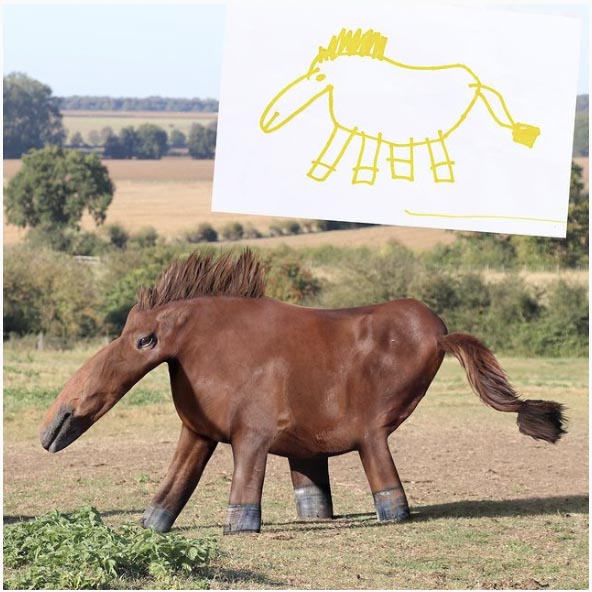
This endeavor is reminiscent of a story from The Lathe of Heaven, blending humor with creativity.
Groundbreaking Research: Graphene on the Moon
Is it a good week for graphene news? You bet it is! Graphene is slated for testing on the Moon, thanks to a collaboration between the Mohammed bin Rashid Space Centre (MBRSC) in the United Arab Emirates and the European Space Agency (ESA). The Rashid rover was initially scheduled to launch to the Moon on November 30, although the launch has been postponed. Once it embarks on its lunar journey, the rover’s wheels will be designed to test how various materials, including graphene, withstand the harsh lunar environment. As reported by Graphene-Info:
Through the Material Adhesion and Abrasion Detection experiment, graphene-based composites on the rover wheels will determine their effectiveness in protecting spacecraft from the Moon’s extreme conditions, particularly from regolith, or lunar dust. Regolith consists of sharp, tiny, and adhesive particles that have posed significant challenges for lunar missions since the Apollo era. It can cause mechanical and electrostatic damage to equipment, as well as pose health risks to astronauts by clogging spacesuit joints, obscuring visors, and eroding protective layers.
“Innovative materials like graphene could revolutionize space exploration. When combined with lunar resources, advanced materials can provide shielding from radiation, protection for electronics, and mechanical resilience against the Moon’s harsh conditions. The Rashid rover presents an unprecedented opportunity to gather data regarding the behavior of graphene composites in a lunar setting,” stated Carlo Iorio, Graphene Flagship Space Champion from ULB.
That’s not all—special graphene-based inks have also been tested on a previously launched rocket.
This experiment will yield fresh insights into the printing of GMR inks in weightless conditions, advancing the development of new additive manufacturing methods in space, including 3D printing. These techniques are crucial for space exploration, where replacement components are often needed and can be produced from functional inks.
Innovative Gaming for Dogs: Unleashing Cognitive Potential
Do you have a dog? Has your furry friend become disinterested in the classic game of fetch? If so, it might be time to explore a new interactive gaming experience designed specifically for dogs. Introducing Joipaw, an innovative video game system that aims to “unleash your dog’s cognitive potential.” (Uh oh: Scanner dog!) Axios reports:
The Joipaw console is equipped with “a dog-tailored touchscreen, a height-adjustable stand, and an automated treat dispenser,” offering a variety of engaging puzzle games that are constantly updated to provide new and exciting challenges.
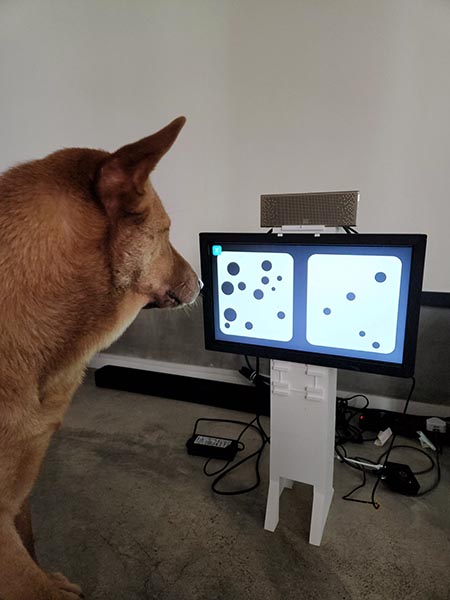
Photo by Dersim Avdar (Kawet’s human, Kawet being the dog), via Axios
How does this interactive system work?
“Dogs wear a tracker on their collar that transmits data regarding their activities to the Joipaw app, including steps taken, time spent resting, playing, and walking,” Avdar explained to Axios.
“They can also engage in games on the console and receive treats as rewards for successful gameplay,” he added. “We gather cognitive data in the background, which is also displayed in the app.”
Avdar envisions developing Joipaw into “Apple Health, but for dogs,” revolutionizing how we track and enhance our canine companions’ well-being.
Interesting concept, indeed.
Medieval Justice: Suing Animals for Damages
It’s undeniable that animals, especially insects, can wreak havoc on homes and crops. Typically, the best course of action is to contact an exterminator and then repair the damages, often at our own expense. However, if we lived in Medieval France, we might have had the option to sue these pesky critters.
According to Ancient Origins, in 1906, Edmund P. Evans released a book titled The Criminal Prosecution and Capital Punishment of Animals, detailing historical animal trials. Remarkably, Evans documented around 200 cases involving donkeys, pigs, and roosters, often depicted in human attire, being brought to court. Even weevils faced legal repercussions.
Cases against larger identifiable animals were usually tried in secular courts, while smaller pests like weevils, rats, or locusts were judged by ecclesiastical courts. These trials adhered to standard court procedures, complete with evidence presentation, witness testimonies, and verdicts. Interestingly, in the case of the weevils, the offending critters were even assigned a lawyer for their defense.
Now that’s a story that deserves its own television adaptation!
The peculiar trial of weevils occurred in the 16th century in southeastern France, where winemakers accused these pests, specifically Rhynchites auratus, of destroying their vineyards. The legal proceedings commenced in 1545.
Unfortunately, the courts didn’t always side with the plaintiffs.
The chair of the ecclesiastical court, Francois Bonnivard, opted not to penalize the oblivious weevils. Instead, he advised the winemakers to repent for their sins by attending three special masses and paying overdue tithes to the church, after which the weevils seemingly left them in peace.
There’s no record of whether there was an animal appellate court!
Discoveries in Space: The James Webb Space Telescope Observes Galactic Collisions
The James Webb Space Telescope is fully operational and has recently focused its powerful lenses on II ZW 96, a pair of galaxies currently in the process of merging—described by NASA as engaging in a cosmic “cavorting.” Located approximately 500 million light-years from Earth in the constellation Delphinus, these two galaxies are well on their way to merging. According to NASA:
The luminous cores of the two galaxies are interconnected by bright streams of star-forming regions, and the spiral arms of the lower galaxy have been distorted due to the gravitational influences of the merging galaxies. These vibrant star-forming regions made II ZW 96 an ideal target for Webb, as the galaxy pair shines particularly bright in infrared wavelengths due to their active star formation.

Such advancements in astronomical observation truly demonstrate the wonders we can achieve.
Reimagining Classic Tales: The Dark Side of Bambi
This year, the 1923 novel Bambi: A Life in the Woods by Felix Salten, which served as the basis for the beloved Disney film, has entered the public domain. This change allows filmmakers and creatives the freedom to adapt it without legal repercussions. As a result, a live-action film titled Bambi: The Reckoning is currently in production.
“The film will be a dark reinterpretation of the cherished story we all know,” director Rhys Frake-Waterfield told Entertainment Weekly. “Drawing inspiration from the visual style of Netflix’s The Ritual, Bambi will transform into a fierce predator lurking in the wilderness. Prepare for a truly terrifying version of Bambi!”
How delightful; just what the world needs!
This isn’t an isolated incident—Frake-Waterfield previously produced Winnie-the-Pooh: Blood and Honey, another adaptation resulting from a public domain transition. For now, we think we’ll stick with the classic Disney versions.
Cozy Family Apparel: Olive Garden’s Matching Pajamas
If you’re a fan of Olive Garden and enjoy wearing pajamas, you’re in for a treat! According to Food & Wine, Olive Garden is following the trend of other food and beverage brands by releasing tie-in merchandise, specifically a matching family set of pajamas designed to celebrate the love of their iconic breadsticks.
The onesie pajamas—available at olivegarden.com starting December 6 at 10 a.m. ET—are described as cozy and hooded, adorned with prints showcasing “the brand’s most iconic offerings,” including pasta, after-dinner mints, and, of course, an abundance of soup, salad, and breadsticks.
These pajamas will be available in a “wide range of sizes for the entire family,” with adult sizes priced at $35 and children’s sizes at $25 (plus shipping). Olive Garden also hints that quantities are limited, stating, “Available only while supplies last, on a first-come, first-served basis.”

No information has been provided regarding whether therapy sessions are included in the cost of the pajamas or if they incur additional expenses.
This Week in Historical Printing, Publishing, and Media Milestones
November 21
1676: Danish astronomer Ole Rømer presents the first quantitative measurements of the speed of light, laying the groundwork for future scientific discoveries.
1694: French historian, playwright, and philosopher Voltaire (born François-Marie Arouet) is born, becoming a key figure in the Enlightenment.
1783: In Paris, Jean-Fr

Sienna Blake is a licensed aesthetic consultant and beauty writer specializing in cosmetic surgery advancements and non-invasive treatments. With a background in dermatology and over eight years of industry experience, Sienna is passionate about helping people achieve confidence through informed beauty decisions. She holds a Bachelor's degree in Health Sciences and regularly collaborates with top plastic surgeons to stay at the forefront of aesthetic innovations. Outside of her work, Sienna enjoys traveling, skincare research, and practicing Pilates.
