


As a seasoned Esthetician with 35 years of dedicated experience, one of the most common queries I encounter is, “How can I eliminate skin discoloration?” This concern spans all ages, from teenagers to seniors, indicating that skin discoloration is a universal issue. Everyone desires flawless skin, free from the necessity of heavy makeup to achieve that coveted even-toned appearance. Understanding this widespread desire, I’m here to share insights into the various causes of unwanted skin discoloration, followed by my expert action plan designed to help you embrace and love the skin you’re in.
First, let’s delve into the underlying causes behind skin discoloration before we explore actionable strategies to address this common concern.
Uncover the Root Causes of Skin Discoloration
Skin discoloration primarily arises from the overproduction of a pigment known as melanin. This overproduction can be triggered by various factors, including genetics, sun exposure, hormonal changes, and skin injuries, such as those caused by blemishes. Once the melanin production is activated, it can be quite challenging to calm the overactive pigment cells, leading to prolonged periods of frustration for those affected. This challenge is often more pronounced the deeper the skin tone is, resulting in discoloration that can linger for months.
Explore the Four Distinct Types of Skin Pigmentation
Understanding Melasma: Causes and Treatments
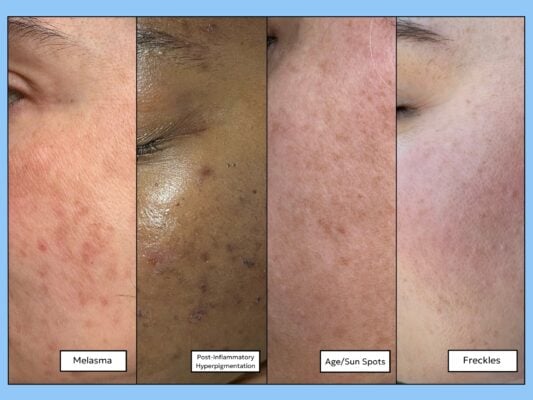
Melasma manifests as large, dark brown or grayish patches, typically appearing on the forehead, cheeks, and around the mouth. This condition is frequently triggered by hormonal changes associated with menopause, pregnancy, and the use of birth control pills. Through my professional experience, I have observed that melasma is rarely seen in teenagers but is most prevalent among women in their 30s, often coinciding with pregnancy. The primary goal when addressing melasma is to calm the overactive melanin cells, allowing them to fade gradually.
Many individuals mistakenly believe that aggressive treatments, such as over-exfoliating or undergoing frequent chemical peels and microneedling, will expedite the fading process. In reality, these approaches can exacerbate the issue by keeping the pigment cells active. It is crucial to adopt a more gentle approach to healing and soothing the skin, as sometimes the key to fading melasma effectively is to do less rather than more.
Combatting Post-Breakout Marks: Essential Strategies
Also referred to as post-inflammatory hyperpigmentation (PIH), these marks appear as small, dark red, or purple spots resulting from trauma to the skin, whether from blemishes, bug bites, cuts, or scratches. Addressing these marks requires a proactive approach to prevent their occurrence.
To effectively prevent post-breakout marks and scars, consider the following:
- Prevent breakouts before they start. While this may sound challenging, working with a skincare professional who specializes in acne can provide you with a tailored action plan that addresses your specific type of acne. As I mentioned in a previous post, Tea Tree Oil can be beneficial for blemish prevention.
- When a breakout occurs, treat it with the appropriate spot treatment at the correct stage in its life cycle. Understanding the life cycle of blemishes can help you prevent unnecessary discoloration.
- Avoid picking at blemishes. While it may be tempting, picking can lead to longer-lasting post-breakout discoloration. Learn how to break the skin-picking habit for good.
I once had a client who struggled with picking her skin throughout her life, and the resulting damage was evident even years later.
Understanding Age and Sun Spots: Prevention and Care
Age and sun spots can range in color from light brown to dark brown, primarily resulting from cumulative sun exposure that tends to manifest in your 40s as pigment cells rise to the surface with age. Those with deeper skin tones may have higher melanin levels, making them more susceptible to these spots compared to individuals with lighter skin tones. However, it’s important to note that everyone will experience some degree of this discoloration as a natural part of the aging process.
Discoloration from aging is not limited to the face; it can also appear on the neck. I personally experienced a condition called poikiloderma, which resulted in discoloration on my neck. Read more about my journey and how I improved it.
Furthermore, the chest area can also be affected by discoloration. I had a severe sunburn in my past, and the discoloration from that incident has persisted for years. You can see the lasting effects of sun damage on my chest.
Freckles: Genetic Factors and Misconceptions
Freckles are small brown spots that typically appear during childhood and are a genetic trait. Everyone is born with perfectly pigmented skin—after all, have you ever seen a baby with freckles?—but for those genetically predisposed, freckles may start to appear as early as age three when their skin is first exposed to the sun.
Interestingly, people with freckles often believe they have more sun damage than those without. This is a common misconception. While freckles are indeed a form of discoloration, they simply result from overactive melanin cells inherited from one or both parents, with redheads being particularly prone to them.
In fact, there’s a growing trend where individuals use makeup to create fake freckles, similar to the “cutesy” effect my client Sabrina Carpenter achieved in a recent photo together.
However, like all forms of discoloration, heat from the sun, saunas, and steam rooms can intensify the appearance of freckles.
Effective At-Home Strategies to Combat Skin Discoloration
Now that you are aware of the various causes of skin discoloration, you might be wondering, what’s next? After years of education and training, along with hands-on experience with thousands of clients, I have developed an effective strategy that can at least prevent discoloration from worsening. With dedication and commitment, you should see visible improvements over time. My clients consistently love the results they achieve with this action plan, and I’m confident you will too.
#1: Encourage Melanin Cells to Rest for Fading
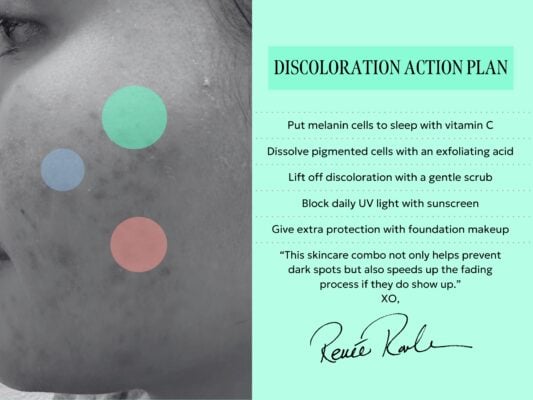
When discoloration appears on the skin, it indicates that the pigment cells are in an active state, and our primary aim is to encourage these cells to settle down. Extensive research indicates that the daily application of a vitamin C serum can significantly help interrupt the signals sent to melanocytes, promoting faster fading of discoloration.
However, it’s crucial to avoid vitamin C acid burns; thus, I recommend using a stable, gentle form of vitamin C, such as Tetrahexyldecyl Ascorbate (THD Ascorbate), which is found in my Vitamin C&E Treatment. This formulation effectively interrupts signals to melanocytes without causing irritation, allowing for smoother and safer treatment.
#2: Effectively Dissolve Unwanted Pigment Cells with Exfoliating Acids
Exfoliating acids, such as glycolic, malic, and lactic acids, play a vital role in improving skin discoloration. When applied to the skin, these acids work to lower the skin’s pH, placing it in an acidic state that facilitates the dissolution and removal of discolored cells. Incorporating leave-on overnight serums like Pore + Wrinkle Perfecting Serum or weekly treatments such as the Triple Berry Smoothing Peel can significantly enhance the skin’s overall tone and texture.
#3: Gently Lift Off Discoloration with a Nourishing Scrub
This step is critical yet often overlooked in skincare routines. Gentle facial scrubs have fallen out of favor with the rise of acid-based treatments, but they remain essential for achieving immediate brightening effects. Using a scrub with round beads, and massaging it over the face for about 60 seconds, can yield gratifying results in lightening pigmentation. For optimal results, I recommend using the Triple Berry Smoothing Scrub 2-3 times a week to reveal a more radiant complexion.
Don’t be skeptical about facial scrubs; they are crucial for effectively removing discoloration and enhancing your skin’s glow.
#4: Consistently Block Daily UV Light with Broad-Spectrum Sunscreen – Indoor and Outdoor
The importance of daily sunscreen is well-known, but it must be applied during all daylight hours, regardless of your location. This means that even if you are indoors with daylight streaming through your windows, those rays can still keep unwanted pigment cells active. Remember, our goal is to encourage melanin cells to rest and fade.
Individuals with oily, acne-prone skin may hesitate to use sunscreen due to concerns about breakouts caused by heavy, oil-laden formulas. However, it’s essential to find a sunscreen that won’t clog pores, such as Weightless Protection SPF 30, which provides effective protection without exacerbating oily skin conditions.
#5: Enhance Protection with Foundation Makeup as a Barrier Against UV Rays
In line with blocking UV light, many people may not realize that makeup, even if it doesn’t explicitly indicate sun protection, can act as a barrier against UV rays. This is due to the presence of iron oxides in many foundations, which are also used in physical-blocking sunscreens. To effectively shield your skin from damaging UV rays, consider your foundation makeup as an extension of your skincare routine. I personally wear it throughout all daylight hours to provide continuous protection.
For those prone to breakouts, selecting the right foundation can be a challenge, as many formulas are notorious for clogging pores. Check out my recommendations for foundations suitable for oily, acne-prone skin types.
With these strategies in place, you now have my comprehensive at-home action plan to help accelerate the fading of skin discoloration.
Embrace the journey towards achieving a more even skin tone — The Renée Way.

Celebrity Esthetician & Skincare Expert
With extensive training in cosmetic chemistry, Renée Rouleau has dedicated over 30 years to researching skin and educating her audience. She has built an award-winning line of products designed for nine unique skin types, ensuring that your face receives the precise care it needs to achieve optimal health and appearance. Renowned among celebrities, editors, bloggers, and skincare enthusiasts worldwide, her extensive knowledge and continuous research have earned her the title of “the most passionate skin practitioner we know” according to Marie Claire.
!function(f,b,e,v,n,t,s)
{if(f.fbq)return;n=f.fbq=function(){n.callMethod?
n.callMethod.apply(n,arguments):n.queue.push(arguments)};
if(!f._fbq)f._fbq=n;n.push=n;n.loaded=!0;n.version=’2.0′;
n.queue=[];t=b.createElement(e);t.async=!0;
t.src=v;s=b.getElementsByTagName(e)[0];
s.parentNode.insertBefore(t,s)}(window,document,’script’,
‘https://connect.facebook.net/en_US/fbevents.js’);
fbq(‘init’, ‘466707850347066’);
fbq(‘track’, ‘PageView’);