


Nature has been a reliable muse for the beauty industry. In its simplest incarnation, the relationship sees the hues of maritime or woodland landscapes acting as creative ground for color applications in cosmetic products. In its more complex facets, the dynamic births science-fueled such as The Unseen’s beetle shell–inspired, holographic hair dyeor Shellworks’ bacteria-derived, sustainable materialVivomer.
For Jesse Adlera multidisciplinary designer, biomolecular scientist, and graduate of the Central Saint Martins MA Material Futures course, creating one hundred percent plant-based pigments for use in color cosmetics began with fungi habituating the earth’s mosses, meadows, and hobby gardens. Fungi are not only biodegradable but also in some instances offer antioxidant and UV protective properties, the latter due to the melanin content of the spores. Despite this, we have only discovered one percent of the world’s five million species, according to scientific estimates.In their most psychedelic form, they could be the mental health medicine of the future; in the skincare realm they offer potent moisturizing properties. Adler took things one step further.
Beginning with her background as a Materials Innovation Researcher at sustainable clothing brand Pangaia, which uses textile waste-derived colored powders to shade its products and focuses on less water-intensive dye methods, Adler took a “high-tech naturalism” approach. I was looking to shape my thesis, I was thinking about the gaps at work that we didn’t have an innovation to fill. Color from natural, renewable sources is one of them. There are mineral dyes, but they’re limited and we ‘re running out of them. They are really dependent on in the beauty industry,” she explains. So much depended on, in fact, that the global cosmetics pigment market is set to hit $20.9 billion in value by 2030. “It was fascinating to me that the clean beauty movement didn’t, and still doesn’t really, extend to all of the ingredients. Color isn’t a part of that,” Adler adds.
She was on a quest to find an alternative to materials such as carbon pigments (which have also been deemed a potential carcinogen) for extra-black mascaras or carmine for red shades. “It’s weird to know that some of the pigments themselves are toxic and harmful. We have this whole idea that everything in our physical world exists in the boxes that we put them in, but on a molecular and atomic level, everything’s always moving, reacting , and interacting with each other. Everything is connected, and we are part of the ecosystem,” she says. After all, historians point to poisonous colors as partially responsible for the physical and mental demise of Napoleon Bonaparte and Vincent van Gogh to name two examples.
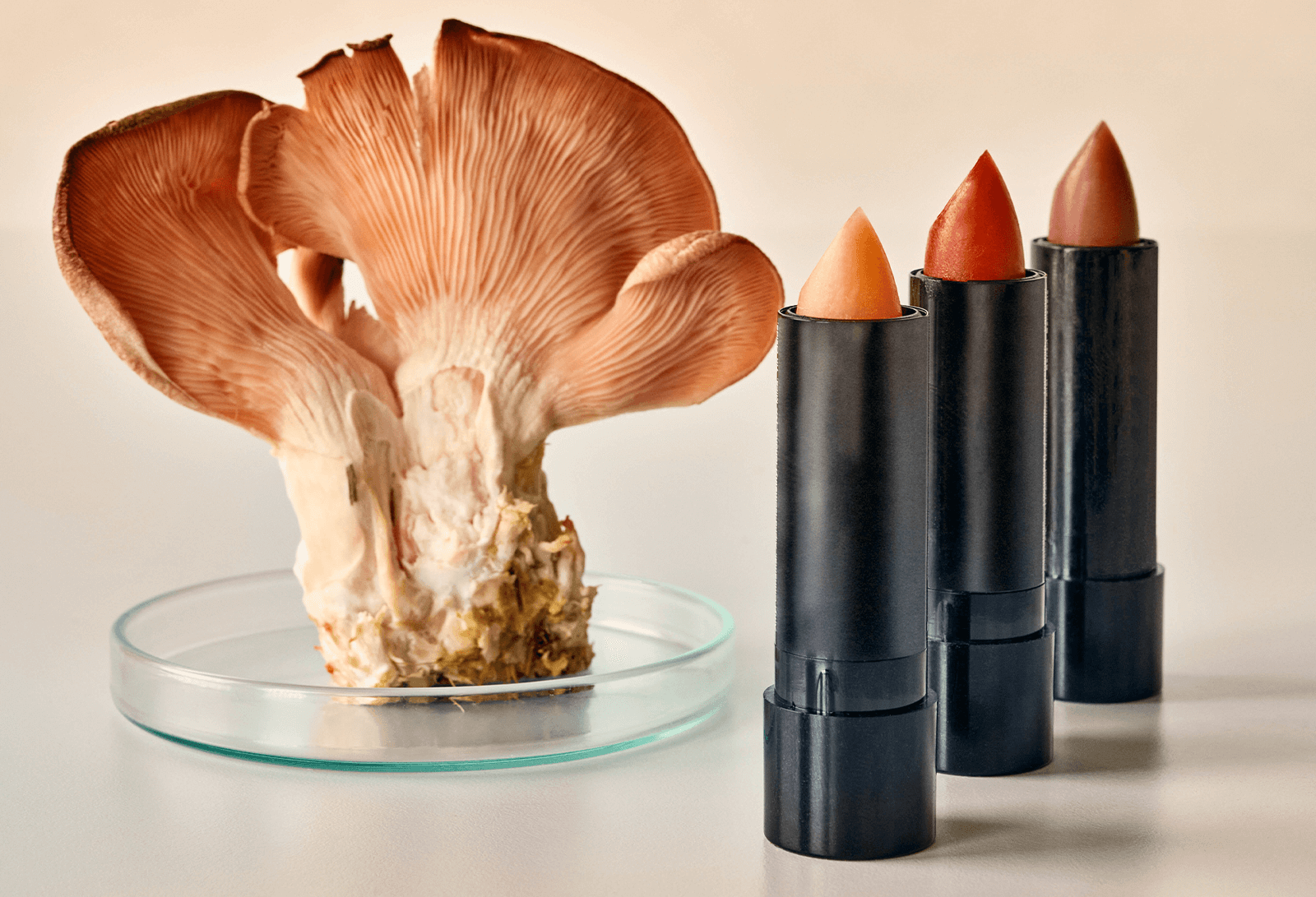
Adler dove into the chromatic possibilities of species such as conk and wood decay fungi with her makeup collection Alchemical Mycology. Products include cream eyeshadow and lipstick in hues of vibrant blood red, cyan blue, golden yellow, pastel lilac, and peachy pink.” organism produces the color. I’m just the extractor. Nature doesn’t see beauty or aesthetics; it only sees function. Nothing in nature is an accident or fruitless,” Adler states. For example, the plant that produces the blue pigment ( with antifungal properties) does so to block other organisms from growing in its food source. Meanwhile, the plant that produces the yellow, orange, and red pigment simultaneously is currently being studied in pharmacological settings for its anticancer properties.
Her mushroom, yeast, mold, and lichen-derived colors can also have further application in the food and textile industries. But would mold-derived colorways potentially bring health hazards with them? Adler’s meticulous process ensures this isn’t the case. beauty of approaching it as a direct chemical extraction―I’m able to pull that molecule out without bringing anything else with it. I’m conducting toxicity testing to validate that nothing is included that shouldn’t be, but, by design, it should be a pure extract,” she reassures.