

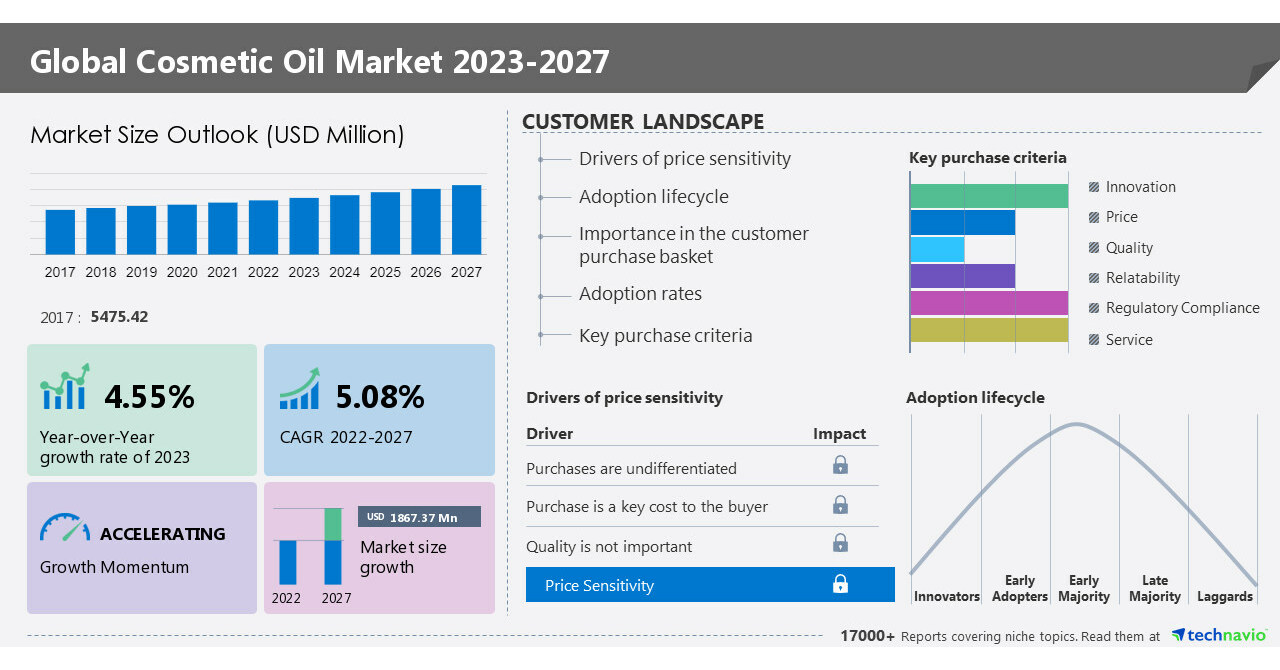
NEW YORK, Jan. 23, 2023 /PRNewswire/ — The global cosmetic oil market is projected to grow significantly, with an estimated increase of USD 1,867.37 million from 2022 to 2027. This market is expected to experience a robust growth momentum, accelerating at a CAGR of 5.08% throughout the forecast period. – Request a sample report
In-Depth Vendor Analysis in the Global Cosmetic Oil Market
Overview of Vendor Offerings –
- AETHOS Essential Oils – This renowned company specializes in a wide variety of essential oils including lavender, eucalyptus, peppermint, lemon, orange, tea tree, cedarwood, and rosemary oils, catering to diverse consumer preferences.
- AMOREPACIFIC Group Inc. – Known for its innovative approach, this company provides cosmetic oils in the form of essential cleansing oils that enhance skincare routines.
- Beiersdorf AG – Offers cosmetic oils like palm kernel oil, which is favored for its moisturizing properties and nourishing benefits.
- CHANEL Ltd. – This luxury brand provides high-end cosmetic oils, including facial oil infused with jasmine extract, known for its soothing and aromatic qualities.
- For an extensive overview of vendors and their product offerings – Buy the report!
Understanding the Vendor Landscape in the Global Cosmetic Oil Market
The global cosmetic oil market is characterized as fragmented, featuring numerous global and regional vendors working to capture market share. Key players include AETHOS Essential Oils, AMOREPACIFIC Group Inc., Beiersdorf AG, Bramble Berry Inc., CHANEL Ltd., Dabur India Ltd., Farsali, Johnson and Johnson, Kao Corp., Khadi Natural, L Brands Inc., LG Corp., LOreal SA, Sanghvi Technologies Pvt. Ltd., Shiseido Co. Ltd., Sophim, The Body Shop International Ltd., The Procter and Gamble Co., Uncle Harrys Natural Products, and Unilever PLC, among others. Each of these companies plays a crucial role in shaping the market dynamics.
Vendors are engaged in fierce competition, primarily focusing on price and product quality. Given the intense rivalry in this sector, it is vital for these companies to create distinctive product offerings that clearly articulate their unique value propositions. To enhance their market presence, leading vendors are actively pursuing acquisition strategies and launching innovative products that resonate with evolving consumer needs.
Insights into Customer Preferences in the Global Cosmetic Oil Market
This report offers valuable insights to help companies assess and formulate effective growth strategies, focusing on the following key aspects:
- Essential purchase criteria
- Current adoption rates
- Adoption lifecycle stages
- Factors influencing price sensitivity
Comprehensive Segmentation Assessment of the Global Cosmetic Oil Market
Detailed Segment Overview
Technavio has meticulously segmented the market based on distribution channels (offline and online) and sources (vegetable oil and mineral oil), allowing for a thorough analysis of market dynamics.
- The offline segment is anticipated to experience substantial growth throughout the forecast period. Retail channels like hypermarkets and supermarkets serve as major offline distribution points for cosmetic oils, simplifying the purchasing journey for consumers. Shoppers benefit from a vast selection of products available in physical stores, enabling them to make informed choices based on price and quality. The convenience of access to products across different platforms is expected to significantly drive the growth of this segment during the forecast period.
Geographical Insights on the Global Cosmetic Oil Market
Analyzing the market geographically, the global cosmetic oil sector is segmented into APAC, North America, Europe, South America, and the Middle East and Africa. This report provides actionable insights and estimates the contribution of each region to the overall growth of the global cosmetic oil market.
- APAC is projected to account for a remarkable 53% of the overall growth in the market during the forecast period. The region’s market growth is driven by increasing consumer awareness regarding the adverse effects of harmful synthetic chemicals commonly used in cosmetic products. As consumers become more informed about the skincare advantages of cosmetic oils, their adoption rates are expected to rise significantly. These factors collectively contribute to the anticipated growth of the regional market throughout the forecast period.
Download a sample report
Exploring Market Dynamics in the Global Cosmetic Oil Sector
Key Growth Drivers – The surge in demand for natural and organic cosmetics is a primary factor propelling market growth. Organic cosmetic oils are derived from natural ingredients, including plant extracts and oils, which appeal to health-conscious consumers. Other natural components like aloe vera, sea salt, jojoba seed oil, apricot kernel oil, beeswax, almond oil, coconut oil, and avocado oil are also included in these formulations. Consequently, manufacturers are increasingly focusing on the development of organic cosmetic oils. Expanding product lines not only helps vendors stand out but also ensures compliance with high purity standards set by regulatory bodies, further fueling market growth during the forecast period.
Emerging Trends – The rise of bio-oils is a significant trend shaping the market. Bio-oils encompass a variety of ingredients such as mineral oil, sunflower seed oil, rosemary oil, chamomile oil, lavender oil, vitamin E, marigold extract, and soybean oil. These components are known for their ability to maintain skin smoothness and enhance the appearance of aging skin on both the face and body. Additionally, plant-based oils can effectively minimize the visibility of wrinkles. This growing interest in bio-oils is expected to contribute positively to the expansion of the global cosmetic oil market during the forecast period.
Challenges Facing the Market – The growing prevalence of counterfeit products presents significant challenges to market growth. Consumers often struggle to differentiate between authentic and counterfeit items. The rise of e-commerce has exacerbated this issue, facilitating the distribution of fake cosmetic products. The appealing low prices of counterfeit items further contribute to their demand. Consequently, genuine vendors may feel pressured to lower their prices, which can adversely affect their profit margins. Therefore, the proliferation of counterfeit products poses a substantial threat to the growth of the global cosmetic oil market in the forecast period.
The interplay of drivers, trends, and challenges significantly impacts market dynamics, influencing
business strategies. Discover more insights by accessing a sample report!
Key Data Points Covered in the Cosmetic Oil Market Report
- Projected CAGR for the market during the forecast period
- Detailed insights into factors driving the growth of the cosmetic oil market from 2023 to 2027
- Accurate estimation of the market size and its contribution to the overall parent market
- Predictions regarding emerging trends and shifts in consumer behavior
- Growth analysis of the cosmetic oil market across APAC, North America, Europe, South America, and Middle East and Africa
- Thorough competitive landscape analysis and detailed vendor information
- Comprehensive examination of factors that may hinder the growth of cosmetic oil market vendors
Gain instant access to over 17,000 market research reports.
Explore Technavio’s SUBSCRIPTION platform
The cosmetic skin care market is projected to grow at a CAGR of 8.72% between 2022 and 2027, with a forecasted increase of USD 79.37 billion. This report provides extensive coverage of market segmentation by product category (face skincare products, body skincare products, and more), distribution channels (offline and online), and geographic regions (APAC, Europe, North America, Middle East and Africa, and South America).
The cosmetic serum market is expected to grow at a CAGR of 4.36% between 2022 and 2027, with a projected increase of USD 1,394.77 million. This report covers extensive segmentation by distribution channel (offline and online), product type (hair care serum, skin, and sun care serum), and geographical distribution (APAC, Europe, North America, Middle East and Africa, and South America).
|
Comprehensive Overview of the Cosmetic Oil Market |
|
|
Report Insights |
Specifications |
|
Page Count |
164 |
|
Base Year |
2022 |
|
Historical Period |
2017-2021 |
|
Forecast Period |
2023-2027 |
|
Growth Momentum & CAGR |
Accelerating at a CAGR of 5.08% |
|
Market Growth 2023-2027 |
USD 1,867.37 million |
|
Market Structure |
Fragmented |
|
Year-over-Year Growth 2022-2023 (%) |
4.55 |
|
Regional Analysis |
APAC, North America, Europe, South America, and Middle East and Africa |
|
Top Market Contributor |
APAC at 53% |
|
Key Countries |
US, China, India, Japan, and Germany |
|
Competitive Landscape Overview |
Leading vendors, market positioning strategies, competitive tactics, and industry-related risks |
|
Key Companies Profiled |
AETHOS Essential Oils, AMOREPACIFIC Group Inc., Beiersdorf AG, Bramble Berry Inc., CHANEL Ltd., Dabur India Ltd., Farsali, Johnson and Johnson, Kao Corp., Khadi Natural, L Brands Inc., LG Corp., LOreal SA, Sanghvi Technologies Pvt. Ltd., Shiseido Co. Ltd., Sophim, The Body Shop International Ltd., The Procter and Gamble Co., Uncle Harrys Natural Products, and Unilever PLC |
|
Market Dynamics Overview |
Parent market analysis, growth drivers, challenges, rapid and slow growth segment analysis, COVID-19 impact and recovery insights, and future consumer behavior trends for the forecast period. |
|
Customization Options |
If our report does not include the specific data you need, feel free to contact our analysts for tailored segments. |
Explore Technavio’s consumer staples market reports
Table of Contents Overview
1 Executive Summary of the Cosmetic Oil Market
- 1.1 Comprehensive Market Overview
- Exhibit 01: Executive Summary – Market Overview Chart
- Exhibit 02: Executive Summary – Data Table on Market Overview
- Exhibit 03: Executive Summary – Global Market Characteristics Chart
- Exhibit 04: Executive Summary – Market Analysis by Geography Chart
- Exhibit 05: Executive Summary – Market Segmentation by Distribution Channel Chart
- Exhibit 06: Executive Summary – Market Segmentation by Source Chart
- Exhibit 07: Executive Summary – Incremental Growth Chart
- Exhibit 08: Executive Summary – Incremental Growth Data Table
- Exhibit 09: Executive Summary – Vendor Market Positioning Chart
2 Detailed Market Landscape Analysis
- 2.1 In-depth Market Ecosystem Analysis
- Exhibit 10: Overview of Parent Market
- Exhibit 11: Key Market Characteristics
</ul

Sienna Blake is a licensed aesthetic consultant and beauty writer specializing in cosmetic surgery advancements and non-invasive treatments. With a background in dermatology and over eight years of industry experience, Sienna is passionate about helping people achieve confidence through informed beauty decisions. She holds a Bachelor's degree in Health Sciences and regularly collaborates with top plastic surgeons to stay at the forefront of aesthetic innovations. Outside of her work, Sienna enjoys traveling, skincare research, and practicing Pilates.
